- English
- Español
- Português
- русский
- Français
- 日本語
- Deutsch
- tiếng Việt
- Italiano
- Nederlands
- ภาษาไทย
- Polski
- 한국어
- Svenska
- magyar
- Malay
- বাংলা ভাষার
- Dansk
- Suomi
- हिन्दी
- Pilipino
- Türkçe
- Gaeilge
- العربية
- Indonesia
- Norsk
- تمل
- český
- ελληνικά
- український
- Javanese
- فارسی
- தமிழ்
- తెలుగు
- नेपाली
- Burmese
- български
- ລາວ
- Latine
- Қазақша
- Euskal
- Azərbaycan
- Slovenský jazyk
- Македонски
- Lietuvos
- Eesti Keel
- Română
- Slovenski
- मराठी
- Srpski језик

From Off-Grid Operation to Ecological Closed Loop: Tesla's Solar Supercharger Station Reshapes the New Paradigm of Energy-Transportation Integration
2025-12-08
As new energy vehicles (NEVs) become a core force in decarbonizing the global transportation sector, the energy supply model of charging infrastructure has long faced a "green paradox" — most charging stations rely on traditional power grids for electricity, and their carbon emission intensity is inconsistent with the original intention of "zero-carbon travel". However, Tesla's recently commissioned "Oasis Project" Supercharger Station, adopting a "fully off-grid" model with an 11MW photovoltaic array paired with a 39MWh energy storage system, has achieved 100% self-sufficiency in charging energy. It not only resolves this paradox but also builds a new ecosystem of in-depth integration between photovoltaic power, energy storage, and transportation, providing a highly valuable practical model for the global energy and transportation transition.
Benchmark Landing: The Technological Core of the World's Largest Off-Grid Supercharger Station
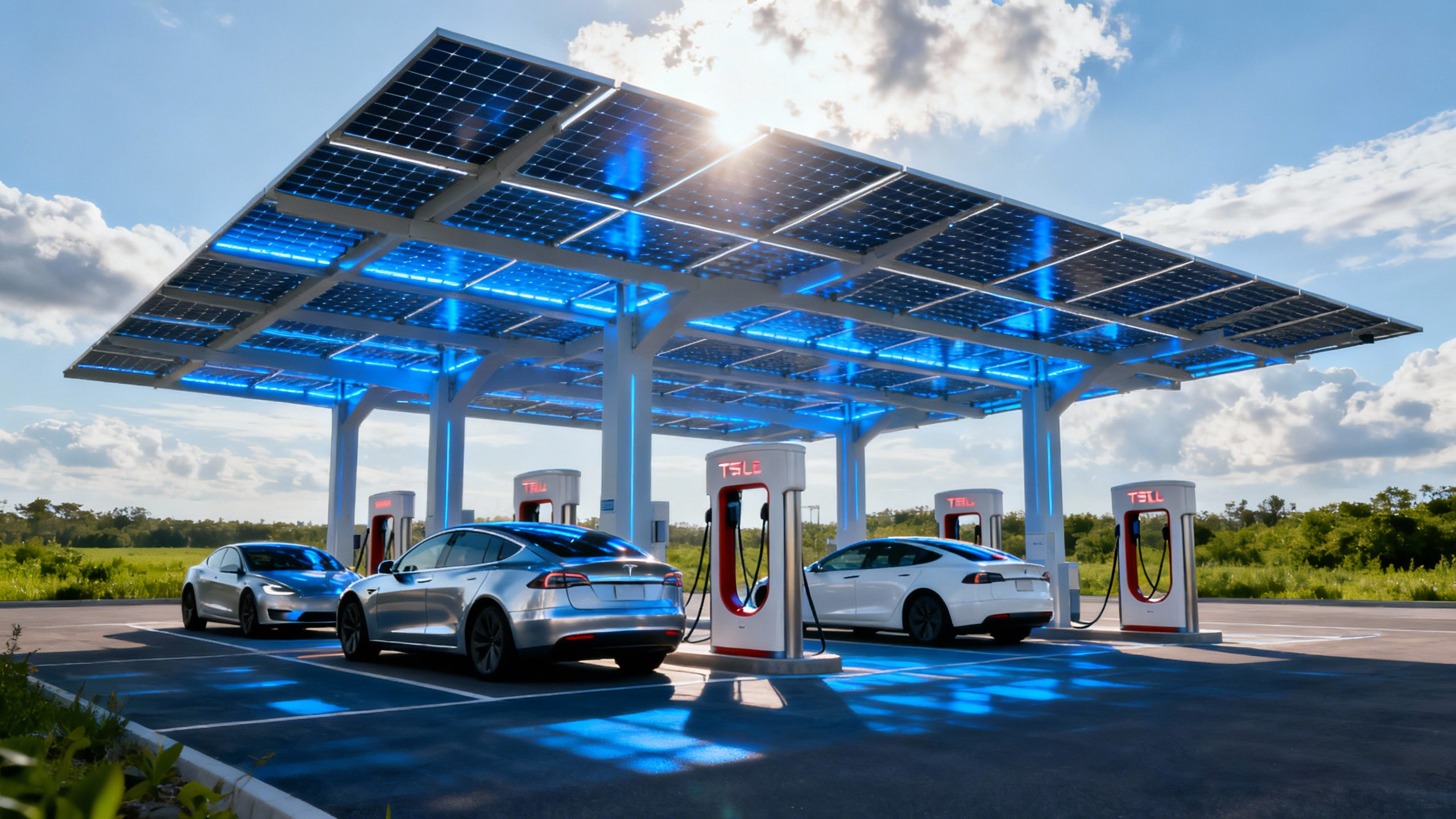
Located in Lost Hills, California, USA, this supercharger station is not a simple expansion in scale but a masterwork of technological integration and model innovation. As Tesla's largest global supercharger station, it covers an area of 12.14 hectares and is situated along Interstate 5, which connects San Francisco and Los Angeles, accurately covering high-frequency intercity travel demand. The entire station is equipped with 168 V4 Superchargers, with a maximum output power of 325 kW per charger, capable of meeting the fast-charging needs of a large number of electric vehicles.
Its core competitiveness lies in an energy supply system completely independent of the public power grid. Tesla has deployed a 11MW solar power generation system at the station, maximizing solar energy capture through a combined layout of ground-mounted photovoltaic arrays and full-coverage solar canopies. It is estimated that the annual power generation can reach 20 GWh, a figure equivalent to the annual electricity consumption of 1,700 American households. To address the intermittency of solar energy, the station is equipped with 10 sets of Tesla Megapack energy storage systems, with a total energy storage capacity of 39MWh, forming a complete closed loop of "photovoltaic power generation - energy storage peak shaving - charging consumption". Even in scenarios where photovoltaic output is insufficient, such as at night or in severe weather, the energy storage system can ensure the all-weather stable operation of the charging station. The only remaining 1.5MW backup power grid serves only as an emergency guarantee in extreme weather, truly realizing the independent control of energy supply.
Notably, the intelligent coordination capability of this system is the key to its efficient operation. The underlying Energy Management System (EMS) can real-time monitor photovoltaic power generation, energy storage system status (SOC), and charging demand, and dynamically dispatch energy flow through intelligent algorithms: photovoltaic power generation is prioritized for charging loads, and surplus electricity is stored in the energy storage system; when photovoltaic output is insufficient, the energy storage system is prioritized to discharge to support charging. The entire process does not rely on the public power grid, fundamentally avoiding energy loss during transmission and maximizing the local consumption rate of renewable energy.
Value Reconstruction: Three Breakthroughs in Photovoltaic-Energy Storage-Transportation Integration
The significance of Tesla's "Oasis Project" goes far beyond the single function of a charging station. Its essence is the reconstruction of energy production, storage, and consumption methods, achieving multiple breakthroughs at the ecological, economic, and social levels, which accurately aligns with the core value of "photovoltaic + energy storage + transportation" integration and development.
At the ecological level, this model truly realizes the closed loop of "charging clean energy vehicles with clean energy". Even if traditional charging stations use green electricity, there are carbon emissions during grid transmission. In contrast, the "Oasis Project" achieves 100% renewable energy supply, reducing thousands of tons of carbon dioxide emissions annually, completely breaking down the barrier between green energy production and green transportation consumption, and providing a replicable solution for in-depth decarbonization in the transportation sector. Under this model, every electric vehicle charged at this station truly achieves full-life-cycle low-carbon travel, greatly enhancing the environmental value of new energy vehicles.
At the economic level, this model effectively solves the problem of grid impact caused by high-power charging facilities and reduces operating costs. With the growth of NEV ownership, the centralized commissioning of high-power fast-charging stations often brings enormous expansion pressure to the distribution network. In contrast, the "off-grid" integrated photovoltaic-energy storage-charging model does not rely on grid expansion and can independently cope with the volatility of charging loads. Meanwhile, by maximizing the use of low-cost photovoltaic electricity, it avoids purchasing high-priced grid electricity during peak hours. Combined with the "peak shaving and valley filling" function of the energy storage system, it significantly reduces the operating costs of the charging station. For Tesla, this model further improves the profit chain of its energy business — from Solar Roof photovoltaic power generation, Powerwall/Powerpack/Megapack energy storage to electric vehicle charging, forming a complete energy ecological closed loop. Data shows that Tesla's energy storage revenue reached $10.086 billion in 2024, a year-on-year increase of 67%, with a gross profit margin of 26.2%. The integrated photovoltaic-energy storage-charging model will undoubtedly further boost the growth of its energy business.
At the social level, this model enhances the reliability of energy supply and grid resilience. Against the backdrop of frequent extreme weather or grid failures, the "off-grid" charging station can serve as an emergency energy supply node, providing power support for electric vehicles and surrounding critical facilities. Meanwhile, this distributed energy model also provides new ideas for the construction of charging infrastructure in remote areas, along highways, and other regions with weak grid coverage, which is expected to accelerate the full coverage of the charging network and further promote the popularization of new energy vehicles.
Industry Insights: The Future Direction of Energy-Transportation Integration
The successful commissioning of Tesla's "Oasis Project" is not accidental but an inevitable result of its long-term layout in the energy business. From household Solar Roof and Powerwall to commercial Powerpack and grid-scale Megapack, Tesla has built a full-scenario energy storage product matrix covering households, commerce, and the power grid, and the "integrated photovoltaic-energy storage-charging" is precisely a key link in its energy ecological closed loop. As of November 2025, Tesla's global Supercharger network has exceeded 75,000 chargers, including over 12,000 in the Chinese market, covering all provincial capitals and municipalities directly under the Central Government. With the replication and promotion of the "Oasis Project" model, the sustainability of its charging network will be further enhanced.
For the entire industry, this model points out three major directions for the integrated development of energy and transportation. First, technological integration is the core path. The physical integration of photovoltaic, energy storage, and charging facilities is only the foundation; more importantly, it is the coordinated optimization of the intelligent energy management system. Through accurate power prediction, load dispatching, and charge-discharge control, the maximum operating efficiency of the system can be achieved. Second, the commercial profit model needs to be diversified. In addition to charging service revenue, future integrated photovoltaic-energy storage-charging projects can also obtain additional benefits by participating in the power auxiliary service market, virtual power plant operations, and other methods, further improving the commercial feasibility of the projects. Third, standardization is a prerequisite for promotion. It is necessary to accelerate the formulation of equipment interface standards, communication protocol standards, and safety standards for integrated photovoltaic-energy storage-charging systems, reduce the integration difficulty of equipment from different brands, and promote the large-scale development of the industry.
From a global perspective, the energy structure transition and transportation electrification have become irreversible trends, and the integrated model of "photovoltaic + energy storage + transportation" is precisely the key to solving the problem of renewable energy consumption and promoting transportation decarbonization. In China, with the in-depth advancement of the "dual carbon" goals (carbon peaking and carbon neutrality), integrated photovoltaic-energy storage-charging projects have been piloted in many cities, but most projects still rely on grid power supply, and "off-grid" projects are still in the exploration stage. The practical experience of Tesla's "Oasis Project" provides valuable references for the construction of relevant domestic projects, which are expected to be widely promoted in scenarios such as highway service areas, logistics parks, and commercial centers in the future.
Conclusion: The significance of Tesla's "Oasis Project" Supercharger Station has long exceeded that of a single charging station. It is a revolutionary practice of energy-transportation integration, marking the mature application of the distributed energy model in the transportation sector. With the continuous decline in photovoltaic and energy storage costs and the continuous progress of intelligent management technology, "integrated photovoltaic-energy storage-charging" is bound to become an indispensable key infrastructure in the process of building a new power system and achieving the "dual carbon" goals. In the future, when such charging stations are spread all over the world, energy production will be more distributed and clean, and transportation will be more zero-carbon and convenient. Tesla is leading this green future with practical actions.