English
 Español
 Deutsch
 Français
 عربي
عربي
Circuit Breaker Guide: Understand MCB Principles, Selection & Tripping for Electrical Safety
Electrical safety hinges on the small circuit breakers inside distribution boxes. Many people confuse circuit breakers with miniature circuit breakers (MCBs), panic when breakers keep tripping, or incorrectly select higher amperage ratings, creating hidden electrical hazards. This article breaks down the working principles and common FAQs of circuit breakers, helping you pick the right product for residential and industrial applications.
How Does a Circuit Breaker Work?
A circuit breaker acts as an intelligent gatekeeper for electrical circuits. It has two independent protection mechanisms to handle overload and short-circuit faults:
- Overload Protection (Thermal Trip) It contains a bimetallic strip. When current exceeds the rated value for a sustained period, heat causes the strip to bend, as the two metals expand at different rates. This movement pushes the mechanical latch and disconnects the circuit. This is a slow-acting protection and will not trip instantly during overload.
Example: Multiple high-power appliances running on the same circuit for a long time raise the current, triggering a trip after several minutes.
- Short-Circuit Protection (Magnetic Trip) An electromagnetic coil is built inside. In the event of a short circuit, an enormous instantaneous current generates a strong magnetic field. The coil pulls the armature rapidly, releasing the latch and cutting off power in milliseconds.
Example: Direct contact between live and neutral wires triggers an immediate trip to prevent arc ignition.
Note: Residual current circuit breakers (RCBOs) add a zero-sequence current transformer. It continuously monitors incoming and outgoing current. If a current leakage or electric shock occurs and creates a current difference, the trip mechanism activates.
Circuit Breaker vs MCB: What Is the Difference?
These two terms are often mixed up. Simply put: An MCB is a type of circuit breaker. Circuit breaker is a general term. It refers to a switch that can make, carry and break normal load current, and automatically cut power under short-circuit or overload faults. Depending on the arc-extinguishing medium, types include air circuit breakers, vacuum circuit breakers, SF₆ circuit breakers, etc.
The air switch we commonly refer to, also known as MCB (Miniature Circuit Breaker), uses ambient air to extinguish electric arcs generated during contact separation. It is widely used in residential end distribution with overload and short-circuit protection. MCCB (Molded Case Circuit Breaker) is also an air circuit breaker with higher rated current for factories and main power feeders.
Reminder: Standard MCBs do NOT offer earth leakage protection. Choose RCBO integrated residual current breakers for shock protection.
Why Does My Circuit Breaker Keep Tripping?
Tripping is not a product failure — it means the breaker activates protection to safeguard your wiring and equipment. There are four common causes:
- Overload Trip: Too many appliances on one circuit push the current above the rated limit, triggering the thermal trip with delayed action.
- Short-Circuit Trip: Live and neutral wires touch directly, creating extreme instantaneous current that triggers the magnetic trip. This is a high-risk fault.
- Earth Leakage Trip (RCBO only): Damaged wire insulation or faulty appliances cause current leakage.
- Aged Breaker: After years of service, internal bimetallic strips and electromagnetic components degrade, leading to random false tripping. Replacement is recommended.
⚠️ Critical Warning: Never install a higher-rated circuit breaker just to stop tripping. This can overheat cables and cause fire hazards.
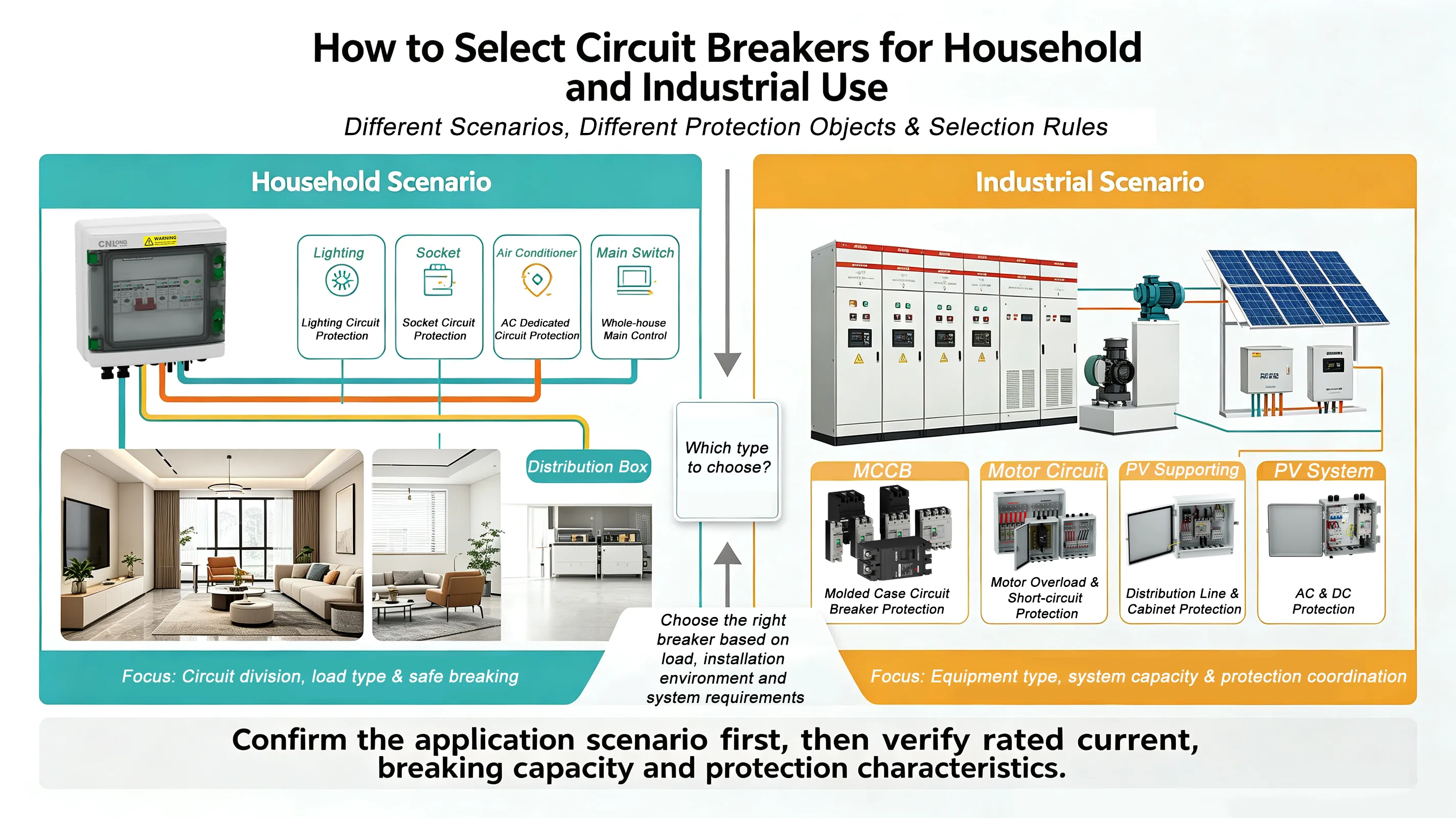
How to Select Circuit Breakers for Homes
Focus on three core parameters: rated current, pole count, and tripping curve
- Lighting circuit: 1P / 1P N, 10A~16A
- General socket circuit: 1P N RCBO, 16A~20A
- High-power circuits for air conditioners & water heaters: dedicated circuit, 20A~32A, RCBO recommended
- Main incoming breaker: 2P circuit breaker, 63A typical
Selection tip: Use separate circuits for high-power loads, prioritize RCBOs for sockets, and avoid overloading a single circuit.
Circuit Breaker Selection for Industrial Applications
Industrial loads such as motors and power cabinets demand high breaking capacity. MCCBs (Molded Case Circuit Breakers) are the primary choice. Vacuum circuit breakers are used for certain high-voltage scenarios.
Key selection factors: rated current, ultimate breaking capacity, impact resistance, and load characteristics. For motor loads, account for large starting current. They support long-time and short-time delay protection, ideal for factories, server rooms and photovoltaic systems.
Tips for Purchasing & Replacing Circuit Breakers
✅ Purchase: Choose certified branded products. Uncertified low-quality breakers may fail to trip during faults and lose protective functions. ✅ Installation & replacement: This is high-voltage work. Always cut off power first. Hire certified electricians; do not attempt DIY disassembly. ✅ Service cost: Depends on breaker model and site difficulty. Costs differ greatly between residential replacement and industrial cabinet maintenance.

Types & Applications of Circuit Breakers
- MCB (Miniature Circuit Breaker): Residential & small distribution boxes, lighting and socket circuits, overload & short-circuit protection.
- RCBO (Residual Current Circuit Breaker with Overcurrent Protection): Preferred for household sockets; triple protection against overload, short circuit and electric shock.
- MCCB (Molded Case Circuit Breaker): Industrial and building main power feeders for high-current distribution protection.
- Vacuum Circuit Breaker: High-voltage switchgear, arc extinguishing inside vacuum chambers.
Closing Thoughts
Small circuit breakers rely on thermal and magnetic trip mechanisms as the first line of defense for electrical safety. Whether you are planning residential wiring or sourcing equipment for factories and photovoltaic projects, correct breaker selection prevents fires and electric shock risks.
Contact our team for professional technical support for residential power distribution or industrial & photovoltaic circuit breaker solutions.