English
 Español
 Deutsch
 Français
 عربي
عربي
CNLONQ PV DC Surge Protector – Safeguard Your PV DC System
In distributed rooftop and commercial‑industrial photovoltaic power stations, transient surge over‑voltages caused by lightning induction and line switching can easily damage expensive core equipment such as inverters and PV modules. CNLONQ PV DC Surge Protector is specially developed for PV DC circuits. It provides reliable transient over‑voltage protection for the DC side of combiner boxes and inverters, reduces equipment damage risks from lightning surges, and improves the overall stability and service life of PV systems.
Product Key Specifications & Advantages
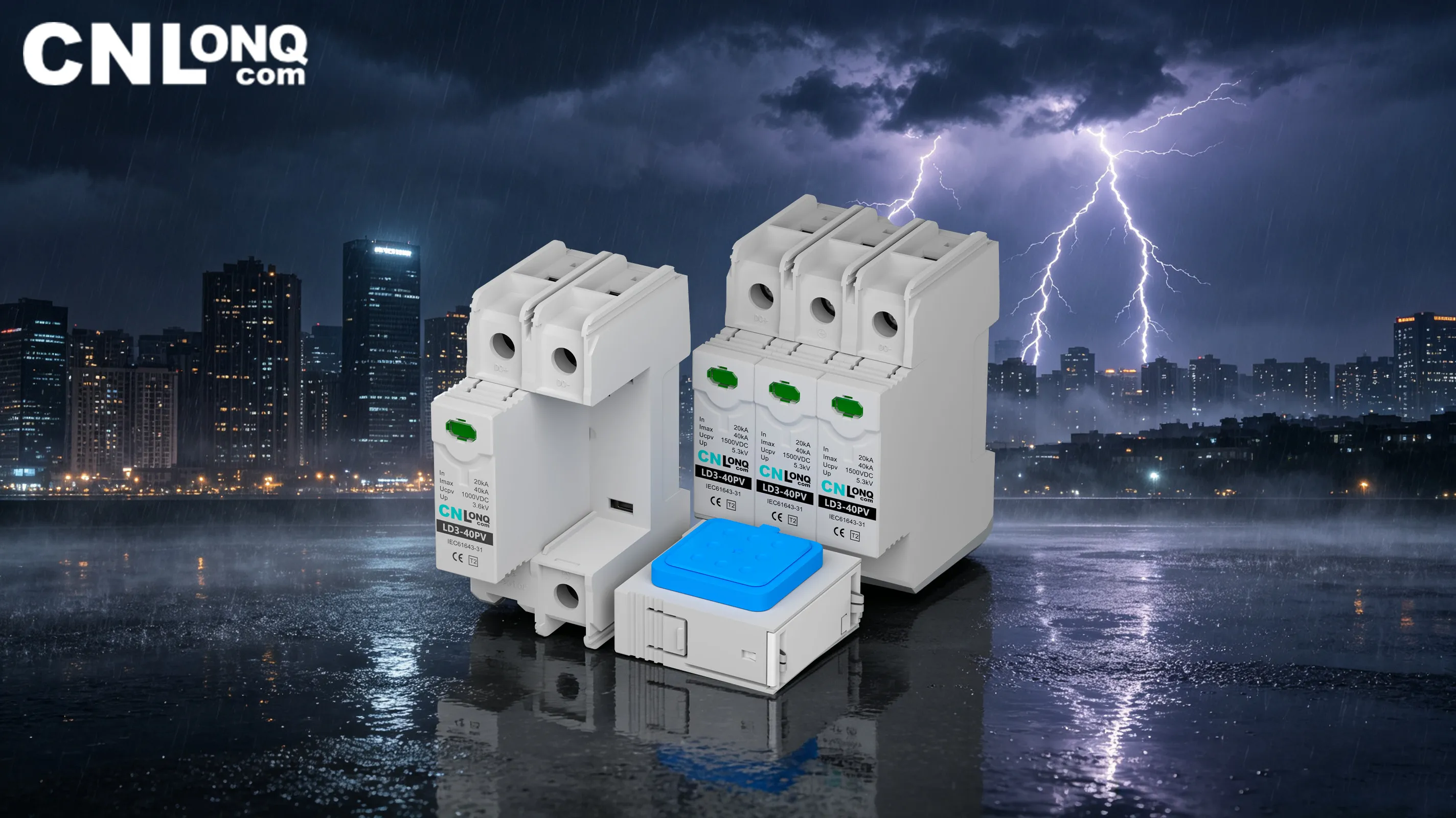
CNLONQ PV DC Surge Protector is available in 2P and 3P pole configurations, covering mainstream PV DC voltage ratings: DC500V, DC600V, DC800V, DC1000V. It fits most PV DC scenarios for residential distributed and commercial‑industrial power plants.
- Dunbaofeng Surge Protection Chip Equipped with proprietary Dunbaofeng surge protection chips inside. It responds in nanoseconds to discharge surge current efficiently and limit residual voltage. Featuring excellent current‑carrying capacity and high‑impact resistance, it adapts to DC PV operating conditions without voltage zero‑crossing points and avoids safety hazards caused by DC follow‑on current.
- High‑Strength Flame‑Retardant PBT Housing The enclosure is made of PBT engineering plastic with outstanding flame‑retardant and high‑temperature aging‑resistant performance. It reaches IK10 mechanical impact resistance rating, resisting on‑site bumps and external force impacts. The housing resists cracking and deformation under harsh outdoor cabinet conditions to enhance overall equipment safety.
- Plug‑in Modular Design with Reusable Base Adopts plug‑gable module structure. When the protection module fails, simply replace the damaged module. The base can be reused repeatedly. No wiring removal is required for quick on‑site maintenance. It greatly reduces later‑stage operation‑and‑maintenance material and labor costs. Designed for standard 35 mm DIN rail mounting for installation inside combiner boxes and DC distribution cabinets.
- Visual Status Indicator Built‑in clear status indicator window. Normal and fault‑failure statuses are clearly distinguishable. Maintenance personnel can judge the working condition of the surge protector visually without professional testing tools. Fault modules can be replaced timely to prevent unprotected system operation.
Working Principle of PV Surge Protectors
A PV DC surge protector is a voltage‑limiting protective device connected in parallel to the PV DC circuit.
- Normal power‑generation status: Internal components maintain high‑impedance status with negligible leakage current. It will not interfere with normal PV power generation and imposes no influence on the system.
- Surge over‑voltage occurrence: When transient high‑voltage surges from lightning induction or switching operations occur, the internal surge protection chip switches to low‑impedance state within nanoseconds. Hazardous surge current is diverted to the grounding system, clamping circuit voltage within a safe range tolerable by backend inverters and PV modules to prevent breakdown damage.
- After surge disappears: Components automatically return to high‑impedance state, and the PV system resumes regular power generation.
Note: PV systems work on DC power without AC voltage zero‑crossing points. Only PV‑specific DC surge protectors shall be used. AC surge protectors must not be substituted, otherwise DC electric arcs may fail to extinguish and cause fire risks.
Why PV Systems Need Surge Protectors
PV arrays are mostly installed on rooftops or open‑air sites. Large‑scale PV arrays act like large receiving antennas and are highly susceptible to electromagnetic pulses induced by nearby lightning strikes, generating transient high‑voltage surges. Operation over‑voltages can also be generated during equipment start‑stop and circuit switching.
- Protect high‑value core equipment: Power devices on inverter circuit boards have limited withstand voltage. Surge impacts may burn out inverters with high repair‑and‑replacement costs. Installing DC surge protectors drastically lowers inverter damage probability.
- Mitigate fire hazards: Over‑voltage breakdown faults in DC circuits may trigger arcing and fire. Surge protectors suppress abnormal over‑voltages and reduce DC‑side fire risks.
- Extend overall system service life: Repeated minor surges accelerate aging of inverters and cable insulation. SPDs reduce latent damages, improve long‑term power‑plant reliability and lower unexpected downtime.
How to Select a Suitable PV DC Surge Protector
- Match system DC voltage: The maximum continuous operating voltage Uc of the surge protector must exceed the maximum DC open‑circuit voltage of your PV system. Select DC500 / 600 / 800 / 1000 V according to actual conditions. Never apply lower‑voltage protectors to higher‑voltage PV systems, otherwise premature failure will occur.
- Choose correct pole type: 2P / 3P: 2P models offer protection for positive‑PE and negative‑PE. 3P versions provide full‑mode protection for positive‑PE and negative‑PE. Prioritize 3P for large commercial‑industrial plants and lightning‑prone zones.
- Application scenarios: 2P is suitable for small‑scale residential distributed PV. For commercial‑industrial power stations and mountainous lightning‑prone areas, select 3P models with sufficient discharge capacity.
- Adopt PV‑specific DC SPD only: Do not use AC SPD as replacement. Verify housing flame‑retardant rating and IK impact grade. Prioritize practical features such as plug‑in replaceable modules and status indicators for convenient future maintenance.
- Installation suggestions: Install DC surge protectors inside PV combiner boxes or close to the DC input terminals of inverters. Reliable grounding is mandatory; poor grounding will drastically degrade lightning‑protection performance.
CNLONQ PV DC Surge Protector balances outstanding protection performance, mechanical robustness and easy maintenance. It fits DC‑side protection requirements for residential, commercial‑industrial and ground‑mounted PV power plants and builds the first safety barrier for photovoltaic power‑generation systems.