 English
 Español
 Deutsch
 Français
 عربي
عربي
DC PV Disconnector: Functions, Types, Selection Guide and Application Scenarios
In photovoltaic (PV) power generation systems, the DC side circuit operates under continuous high-voltage live conditions all year round, serving as a critical link for safe operation, maintenance, and fault protection of power stations. The DC PV disconnector is a specialized electromechanical switching device designed exclusively for PV DC systems. It is primarily installed between PV module arrays, junction boxes, and inverters, acting as an indispensable fundamental safety component of PV systems. Unlike circuit breakers and fuses that focus on fault protection, it takesphysical isolation as its core function, while integrating circuit switching, safety protection, and system operation and maintenance. It is widely applied in residential PV systems, commercial and industrial distributed PV plants, large-scale ground-mounted PV power stations, and solar-energy storage integrated systems. This article comprehensively elaborates on its core functions, current isolation performance, mainstream types, key selection criteria, and practical application scenarios.
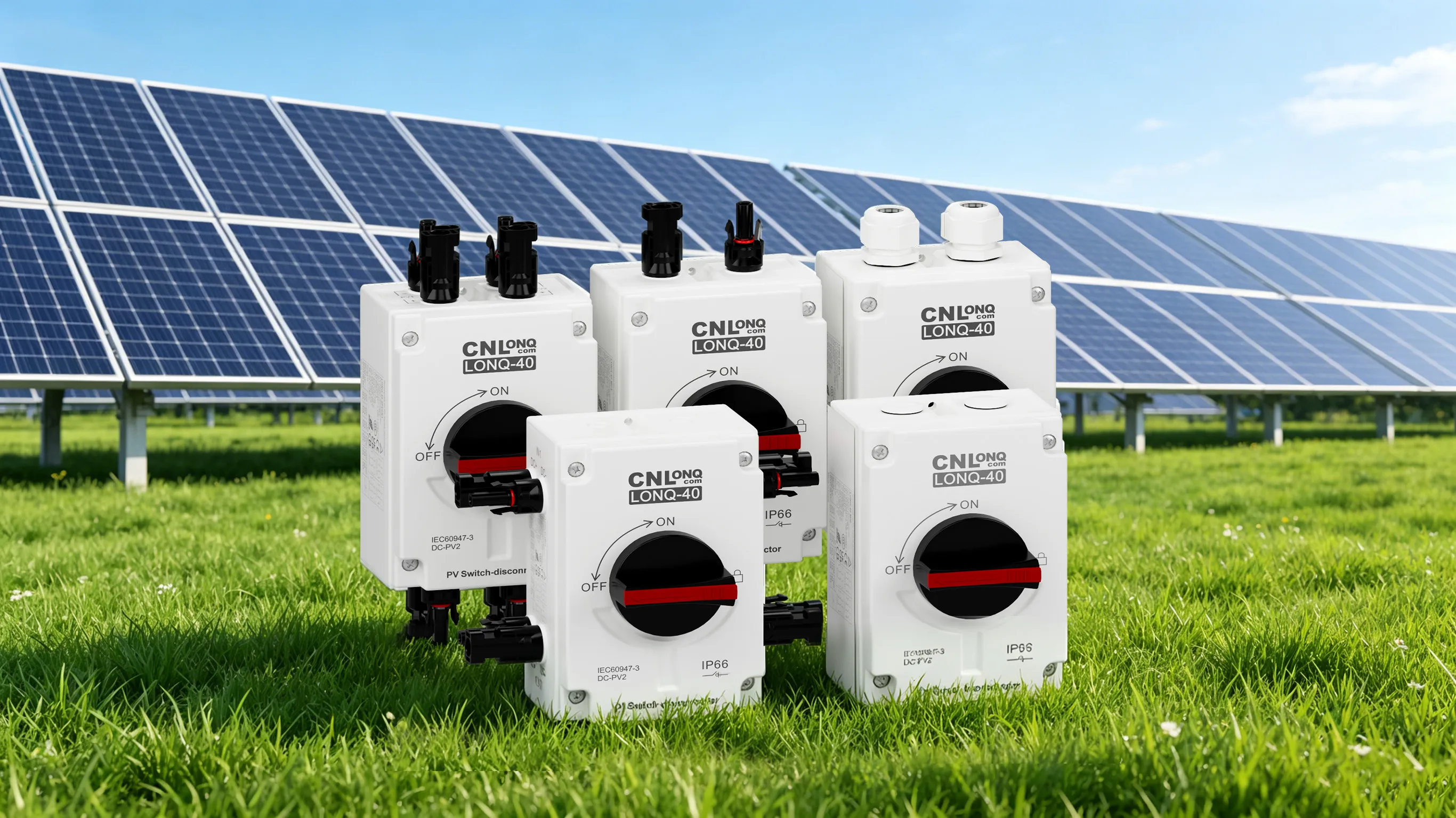
- Core Functions of DC PV Disconnectors
Developed to adapt to the unique characteristics of PV DC circuits, including unidirectional conductivity, easy arc generation, and 24/7 live operation, DC PV disconnectors focus on system safety and operational management, with four major core functions as follows:
1.1 Physical Power Isolation for Maintenance Safety
This is the most vital function of DC PV disconnectors. PV modules generate DC power once exposed to sunlight and cannot be powered off arbitrarily like AC grid systems. During the maintenance, commissioning, or replacement of inverters, junction boxes, and transmission lines, the high-voltage DC poses high risks of electric shock and arc burns for maintenance personnel. The disconnector can mechanically cut off the DC circuit and form a clear physical breakpoint, completely disconnecting the electrical connection between the PV array and downstream equipment. This ensures zero circuit voltage during maintenance and debugging, fundamentally protecting personal and equipment safety. Most models support lockout/tagout (LOTO) functions to prevent accidental closing and power transmission, complying with international electrical safety operation standards.
1.2 No-load/Light-load Circuit Switching and System Start-Stop Control
Qualified DC PV disconnectors feature reliable light-load switching capacity under rated operating conditions. They can manually close and open DC circuits under no-load or light-load states to realize start-stop control of the PV DC side. In daily maintenance, individual or multiple PV branches can be cut off separately without shutting down the entire power station, leaving other branches operating normally and greatly improving maintenance flexibility.
1.3 Fault Sectional Isolation to Minimize Failure Impact
In case of DC circuit faults such as short circuits, current leakage, module failures, and line aging damage, the corresponding branch disconnector can be quickly opened to isolate the faulty section from the normal power supply system. This prevents fault propagation, avoids secondary accidents including arc spread, line burnout, and inverter damage, effectively reduces power station failure losses, and shortens fault troubleshooting and repair time.
1.4 Adapt to PV Operating Conditions and Resist Harsh Environments
Specially designed for long-term outdoor continuous operation, PV disconnectors deliver excellent dustproof, waterproof, anti-aging, and high/low temperature resistance, adapting to harsh outdoor environments such as strong sunlight, rain, snow, and wind-blown sand. They ensure long-term stable operation of DC circuits. Meanwhile, they can effectively suppress electric arcs generated during DC switching, eliminating fire and equipment burnout risks caused by difficult-to-extinguish DC arcs and improving the overall fire safety level of PV power stations.
- Can DC PV Disconnectors Fully Isolate Current?
DC PV disconnectors can achieve complete and reliable current isolation, which is their core advantage over ordinary DC switches and circuit breakers.
In terms of structural principles, PV-specific DC disconnectors form a visible and standardized air-insulated breakpoint after opening. The contact separation distance fully complies with PV electrical safety standards with superior insulation performance. When open, there is no electrical connection in the circuit, which can completely block operating current and residual induced current without leakage, virtual connection, or micro-conduction issues.
It is essential to distinguish it from circuit breakers: circuit breakers are designed to cut off faulty short-circuit current for protection purposes, while disconnectors focus on static electrical isolation. The open state guarantees a zero-voltage circuit, meeting the safety isolation requirements for power maintenance. Under rated voltage and current conditions, qualified DC PV disconnectors achieve 100% complete current isolation, serving as the only compliant safety isolation device for the DC side of PV systems.
Supplementary Note: Disconnectors are prohibited from breaking large faulty current. They are only applicable for no-load/light-load switching and static isolation. Fault large current must be cut off by fuses or DC circuit breakers first before the disconnector performs safety isolation.
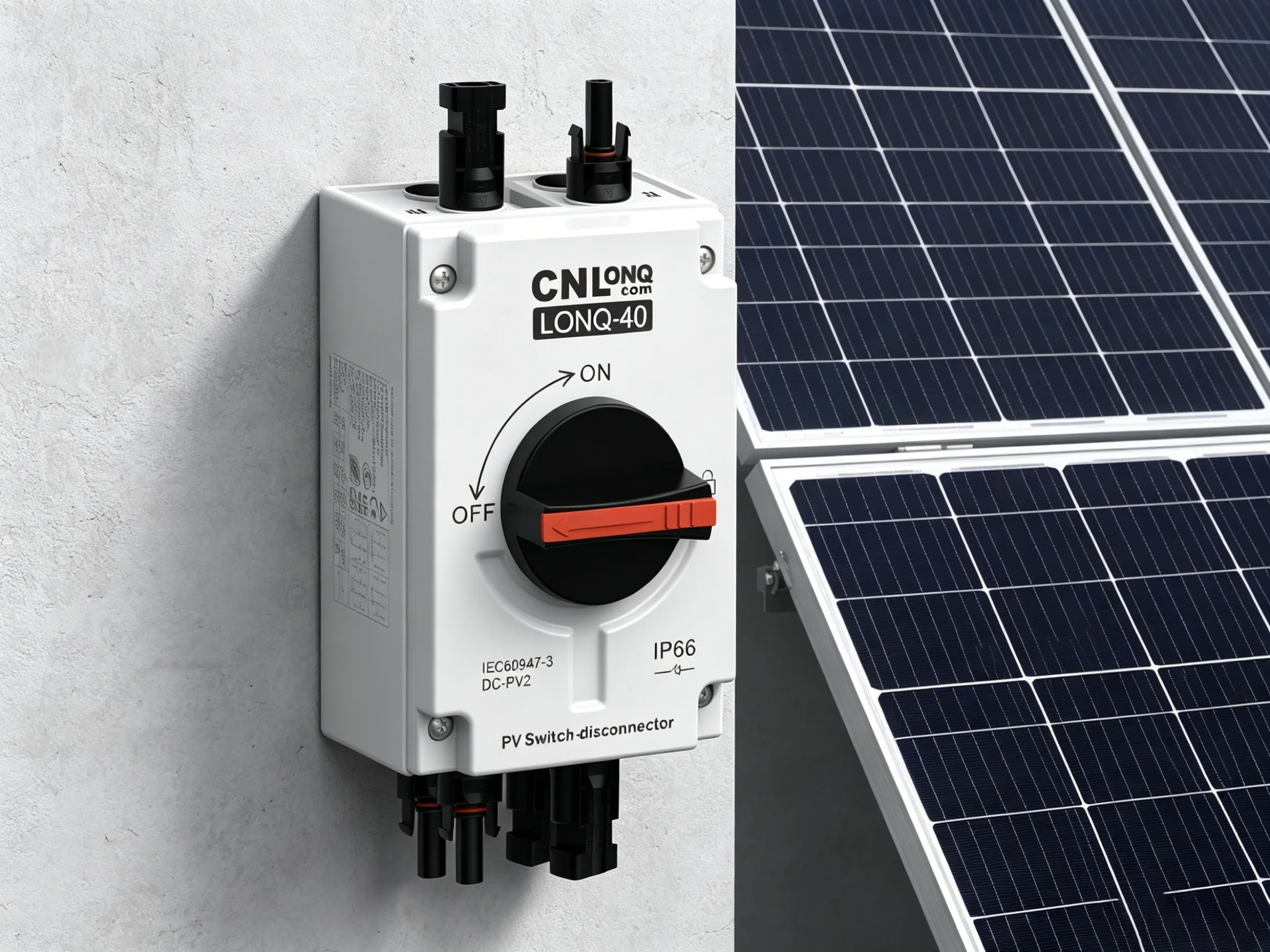
- Main Types of DC PV Disconnectors (By Input/Output Circuit)
According to the differences in PV branch access and bus layout, DC PV disconnectors are divided into four mainstream types: 1-in-1-out, 1-in-2-out, 2-in-1-out, and 2-in-2-out. Each type adapts to distinct power station layouts and bus requirements with differentiated functions and application scenarios:
3.1 1IN1OUT (1 Input 1 Output) Single-channel Isolation Type
As the most basic and widely used standard model, it supports one-to-one switching and isolation of a single PV branch with one input and one output circuit. Featuring a simple structure, high stability, and low failure rate, it is suitable for independent control of single PV string circuits and serves as the standard configuration for small-scale PV systems.
3.2 1IN2OUT (1 Input 2 Output) One-to-two Distribution Type
Equipped with one DC input and two independent outputs, it diverts a single PV DC power supply into two output channels to supply power and control two independent loads. The main circuit can be fully switched on/off, and some models support independent single-output control. It is ideal for scenarios where a single PV array supplies power to two small inverters or dual loads.
3.3 2IN1OUT (2 Input 1 Output) Dual-channel Bus Type
Designed with two independent DC inputs and one centralized output, it converges two separate PV branches into a single output for unified management. The two input channels are mutually independent, enabling isolated maintenance of a single faulty branch without affecting the other normal branch. It simplifies system wiring and eliminates the need for additional bus equipment.
3.4 2IN2OUT (2 Input 2 Output) Dual-channel Independent Isolation Type
It features two fully independent input and output circuits with no mutual interference. It can manage two separate PV DC branches simultaneously, supporting independent single-channel opening/isolation and maintenance, as well as synchronous switching of both channels. With high integration and flexible functions, it integrates bus and independent isolation capabilities, perfectly adapting to medium and large-scale PV systems with multiple parallel branches.
- DC PV Disconnector Selection Guide: How to Choose the Right Model
Model selection should be comprehensively determined based on the PV system voltage level, branch quantity, power parameters, installation environment, and maintenance requirements, following three core principles: parameter matching, circuit adaptation, and scenario compliance. The detailed selection criteria are as follows:
4.1 Confirm Circuit Type and Match Input/Output Specifications
Select models according to PV branch layout: Choose the 1IN1OUT type for independent control of single branches and small residential PV systems; select the 1IN2OUT type for single-array dual-load power distribution scenarios; select the 2IN1OUT type for dual-branch convergence and single-output scenarios; select the 2IN2OUT type for parallel dual-branch commercial and industrial power stations requiring separate maintenance and isolation to optimize layout and reduce wiring costs.
4.2 Match Rated Voltage and Current Parameters
Voltage matching: Most residential PV systems adopt 1000V DC, while large-scale ground-mounted power stations generally use 1500V DC. The disconnector voltage grade must strictly match the system voltage; low-voltage switches are forbidden for high-voltage systems to avoid insulation failure and safety hazards. Current matching: Select the rated current based on the maximum operating current and short-circuit current of each PV branch. The switch rated current shall be no less than 1.25 times the maximum branch operating current to reserve overload margin and prevent equipment overheating and aging caused by long-term full-load operation.
4.3 Adapt to Installation Environment and Protection Grade
Outdoor exposed installations (rooftop, ground power stations) require models with IP65 or higher protection grade, featuring waterproof, dustproof, UV-resistant, and wide temperature resistance for harsh outdoor conditions. For indoor cabinet or junction box internal installation, IP54 or above models are sufficient. Priority shall be given to products with arc-proof and lockable designs to meet safety maintenance specifications.
4.4 Verify Switching Performance and Compliance Standards
Only PV-specific DC disconnectors with DC arc extinction capabilities are allowed to adapt to long-term live PV operating conditions; ordinary AC switches are prohibited for DC PV systems. Products must comply with national PV electrical safety standards and IEC international industry standards with authoritative certification to ensure power station compliance acceptance and long-term stable operation.
4.5 Select Functional Configurations Based on Maintenance Requirements
For power stations requiring high maintenance flexibility, prioritize models with independent single-channel switching, visible breakpoints, and lockout/tagout functions. For simple small-scale PV systems, basic economical models are available to balance cost and practicality.
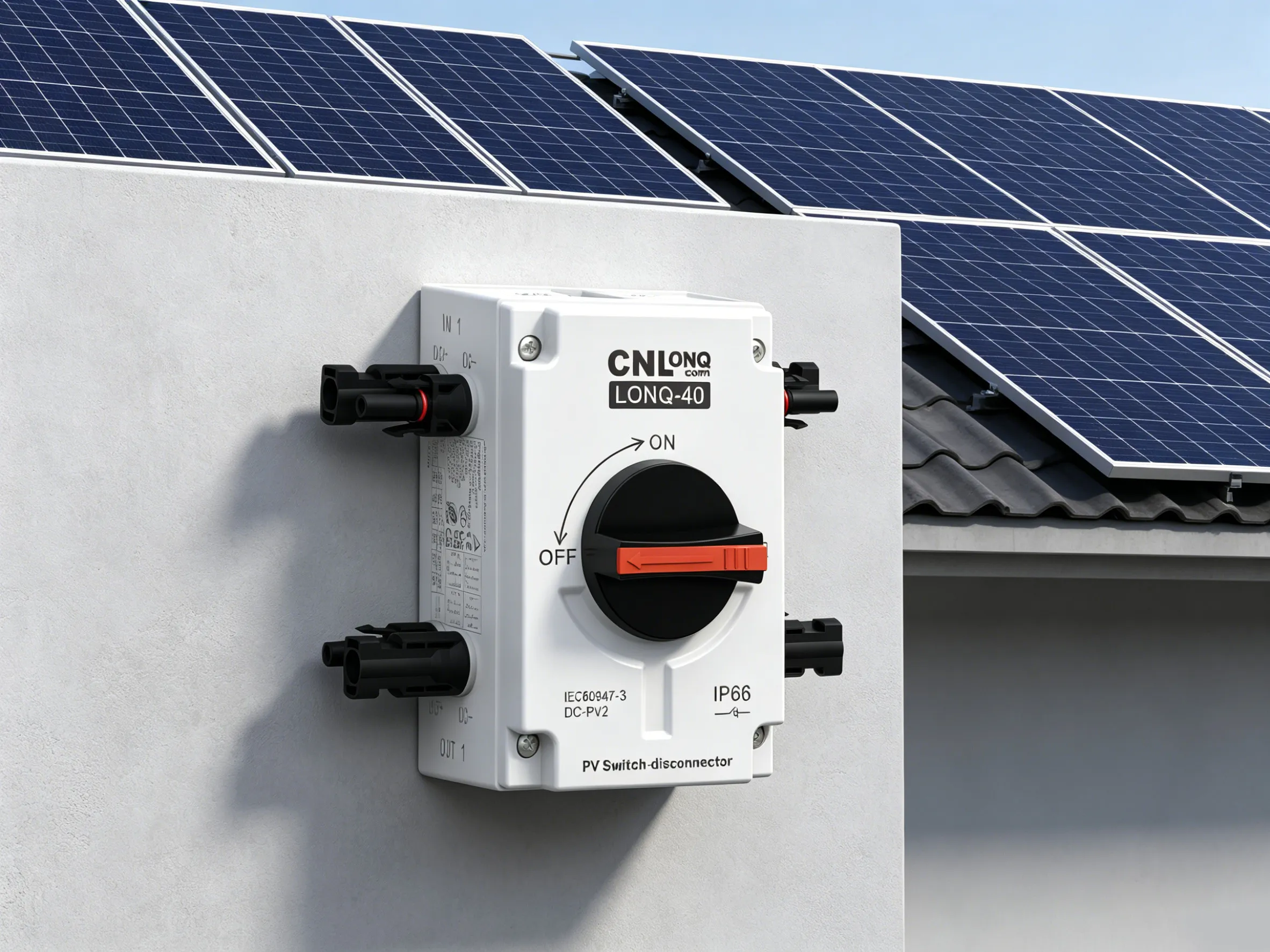
- Core Application Scenarios of DC PV Disconnectors
As essential components for all DC-side PV systems, DC PV disconnectors cover a full range of application scenarios from small residential power stations to large-scale ground-mounted PV bases and solar-storage integrated systems:
5.1 Residential Distributed PV Systems
1IN1OUT disconnectors are mainly adopted for rooftop residential PV and small household energy storage systems, installed between PV modules and grid-tied inverters. They realize system start-stop control and power-off isolation during maintenance, eliminating high-voltage DC electric shock risks and serving as mandatory safety devices for residential PV grid connection and acceptance.
5.2 Commercial & Industrial Distributed PV Systems
Commercial and industrial rooftop PV systems (factories, malls, office buildings) feature numerous scattered branches, mostly equipped with 2IN1OUT and 2IN2OUT disconnectors integrated inside DC junction boxes or at the DC input end of inverters. They support multi-branch convergence and independent fault isolation, reducing the impact of single-branch faults on the entire power station and improving operational stability and maintenance efficiency.
5.3 Large-scale Ground-mounted PV Power Stations
Large-scale PV bases built on mountains, deserts, and plains generally adopt 1500V DC systems with large-scale branches and numerous devices. High-power 1IN1OUT and 2IN2OUT disconnectors are widely used for graded isolation of string branches, junction boxes, and centralized inverter front ends, realizing hierarchical station management and accurate fault troubleshooting to ensure safe and stable operation of large-scale power stations.
5.4 Solar-energy Storage Integrated PV Systems
Solar-storage hybrid power stations and off-grid PV energy storage systems have complex DC circuits including PV arrays and energy storage batteries. Multiple types of disconnectors are used in combination to isolate PV generation branches and energy storage branches separately, avoiding bidirectional current impact, realizing independent operation and maintenance of power generation and energy storage units, and ensuring safe switching of solar-storage systems.
5.5 Special Small-scale PV Systems
Miniature 1IN1OUT disconnectors are applied to small DC PV devices such as PV street lights, PV water pumps, household off-grid PV equipment, and vehicle-mounted PV power supply systems, realizing equipment start-stop control and power-off protection to improve the safety of small PV devices.
- Conclusion
The DC PV disconnector is a core safety component of the DC side of PV systems, with core values of complete physical isolation, maintenance safety guarantee, circuit switching control, and fault range limitation. Its four mainstream models (1IN1OUT, 1IN2OUT, 2IN1OUT, 2IN2OUT) fully adapt to various PV layouts including single-branch, multi-branch, convergence, and power distribution scenarios. Accurate model selection based on system voltage and current parameters, branch quantity, installation scenarios, and maintenance requirements can maximize equipment performance, ensuring long-term safe, stable, and compliant operation of PV power stations. It is an irreplaceable fundamental safety device in the construction and maintenance of PV systems.
