English
 Español
 Deutsch
 Français
 عربي
عربي
PV Combiner Box Complete Guide: How to Choose the "Power Heart" of Your Solar Plant? Global Climate Solutions for Every Environment
Date:7/16/2026 10:40:22 AM Click:282
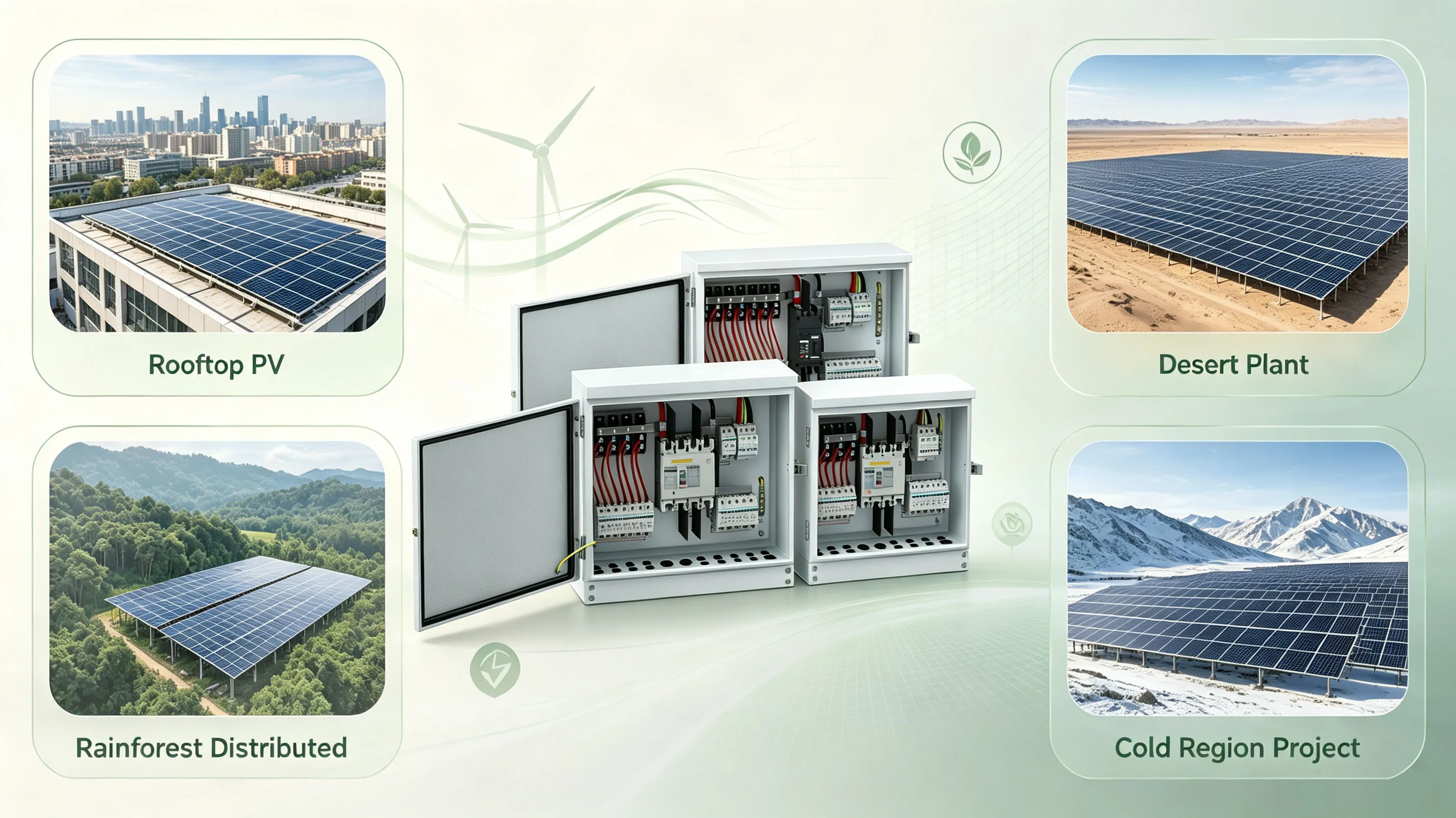
From German rooftops to Australian deserts, from Southeast Asian rainforests to Nordic snowfields — solar panels are continuously converting sunlight into electricity. But did you know? This power doesn't flow directly from the panels to the inverter. There's an often-overlooked yet critical "power hub" working silently in between.
It's the PV combiner box.
Many people confuse it with the junction box on the back of solar panels. And many projects suffer costly downtime in extreme weather because they chose low-quality combiner boxes. In this article, we'll break down everything about PV combiner boxes from A to Z — and show you why CNLONQ combiner boxes deliver 10 years of reliable operation in every climate on Earth.
1. What is a PV Combiner Box? Why Does Every Solar Plant Need One?
🔍 Simple Definition
A PV combiner box is a weatherproof electrical enclosure installed between the solar array and the inverter. It "gathers" DC power from multiple PV strings into a single output line that feeds into the inverter.
Think of it this way: if solar panels are tributaries and the inverter is the downstream reservoir, the combiner box is the "water control hub" where tributaries meet the main river — it keeps the flow smooth while providing flood protection when needed.
💡 Why Are Combiner Boxes Essential for PV Systems?
1️⃣ Reduce Cabling Costs & Speed Up Installation
Imagine a 100kW solar plant with 16 PV strings. Without a combiner box, you'd need to run 16 separate cable pairs from the roof to the inverter room — high material costs, messy wiring, and long installation times.
With a combiner box? All 16 strings merge into one main output line, reducing cable usage by over 70% and cutting labor costs in half.
2️⃣ Centralized Protection for Maximum Safety
A combiner box isn't just a "junction box" — it's the safety protection center for the entire DC side:
-
String overcurrent? Fuses blow in milliseconds, isolating the fault without affecting other strings
-
Lightning surge? SPD surge protectors discharge instantly, safeguarding expensive inverters
-
Short circuit? DC circuit breakers trip rapidly, preventing DC arc fires
Here's the critical fact: DC arcs don't self-extinguish like AC arcs — once an arc starts, it's a continuous fire hazard. The combiner box's centralized protection structure contains these risks inside a "steel box."
3️⃣ Easier Maintenance, Lower O&M Costs
Need to service the plant? No need to climb onto the roof and disconnect panels one by one — you can achieve safe isolation of the entire array right at the combiner box.
This is especially important for large ground-mount plants and distributed rooftop projects — maintenance personnel don't need to work for hours in high heat, at heights, or in bad weather. Service time drops from hours to minutes.
4️⃣ Flexible Expansion for Phased Construction
Building your project in phases? Adding more PV strings later? The combiner box's standardized multi-input design means plug-and-play expansion without major rewiring.
2. 90% of People Get This Wrong: Combiner Box ≠ Junction Box!
This is the most common misconception in the industry. Many new procurement staff think "they're both boxes, basically the same" — and end up buying the wrong equipment, causing safety accidents.
Combiner boxes and junction boxes operate at completely different system levels.
|
Comparison
|
PV Combiner Box | PV Module Junction Box |
| System Level | Plant-level core equipment | Per-module accessory |
| Location | End of PV array / before inverter | Mounted on back of every solar panel |
| Core Function | Multi-string combining full DC protection | Internal wiring connection for single panel |
| Internal Components | DC fuses, breakers, SPD, grounding busbar | Only bypass diodes, small terminals |
| Quantity | 1 to several per array | 1 per solar panel (standard) |
| Value | Core protection equipment | Module accessory part |
Simple analogy:
-
Junction box = wall socket in each room, only powers that room
-
Combiner box = electrical room for the entire building, manages full building power main breaker surge protection safety
Important Warning: Some unscrupulous sellers pass off ordinary junction boxes as combiner boxes at half the price — but they have no fuses and no SPD inside. Installing them in your plant is like planting a ticking time bomb. In lightning-prone areas, one strike can take out an entire string of panels.
3. What's Inside a Quality Combiner Box?
Many people only look at enclosure size and number of inputs, but they miss that internal component quality is the soul of a combiner box.
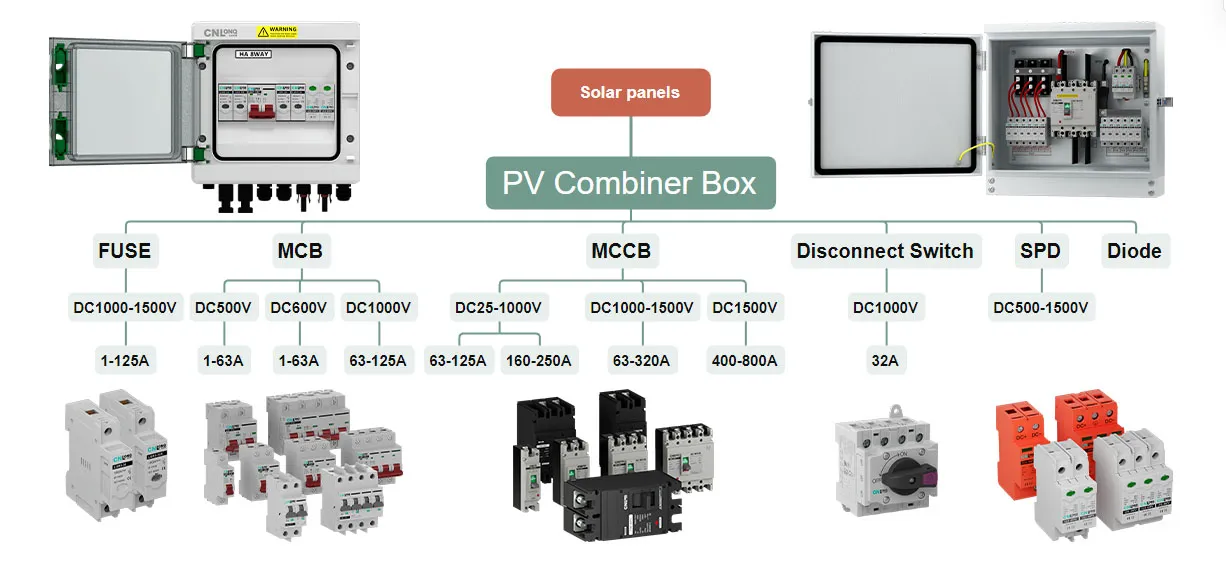
A standard CNLONQ PV combiner box includes these core components:
🔹 1. String DC Fuses
Each PV string has its own DC fuse, 10×38mm standard size, UL certified.
-
Function: Blows in milliseconds during string overcurrent or short circuit, isolating the faulty string without affecting other strings
-
CNLONQ standard: International first-tier brand fuse elements, breaking capacity up to 10kA, no aging or false tripping in extreme temperatures
🔹 2. Main DC Circuit Breaker / Disconnect Switch
The "main switch" of the combiner box, responsible for total power disconnection.
-
Function: Safe isolation during maintenance, total protection during faults
-
CNLONQ standard: Specialized DC circuit breaker, DC 1500V rated, with visible break point — when you flip it off, it's truly off. Unlike cheap no-name brands with "fake disconnection" that still carries voltage, creating safety hazards
🔹 3. SPD Surge Protective Device
The "lightning rod" of the plant, defending against lightning strikes and transient voltage surges.
-
Function: Discharges induced lightning and switching overvoltages to ground instantly, protecting expensive downstream inverters
-
CNLONQ standard: Class II SPD, Imax 40kA, with remote alarm interface — auto-alerts when failed, no need for manual inspection. You can't drive out to the plant every day to check boxes during thunderstorm season, can you?
🔹 4. Input/Output Terminal Blocks
The "connection interface" for PV cables.
-
Function: Secure connection for PV-specific cables, prevents loosening
-
CNLONQ standard: Direct MC4 connector input, no wire stripping needed, waterproof and dustproof — far better protection than ordinary terminal blocks, zero dust ingress in harsh weather
🔹 5. Grounding Busbar
The "lifeline" for equipment safety.
-
Function: PV array grounding equipment enclosure grounding, dual protection
-
CNLONQ standard: Thickened tinned copper busbar, excellent conductivity, no oxidation, no rust for 10 years
🔹 6. Smart Monitoring Module (Optional)
The "smart brain" of the plant.
-
Functions: Per-string current monitoring, voltage monitoring, box temperature monitoring, remote communication
-
CNLONQ advantage: Supports RS485/4G/WiFi communication — check every string's performance on your phone app, instantly locate faulty strings, no need for manual string-by-string troubleshooting
🔹 7. Protective Enclosure
The "armor" for all internal components.
-
CNLONQ standard: IP65/IP66 protection rating, cold-rolled steel with powder coating or stainless steel options, UV-resistant, salt-spray resistant, waterproof and dustproof
-
Global climate adaptation: From -40°C Nordic snowfields to 55°C tropical deserts, from coastal salt spray environments to high-altitude strong UV areas — CNLONQ combiner boxes run reliably everywhere
4. How to Choose a Combiner Box? Avoid These 5 Pitfalls & Save Your Plant Thousands
❌ Pitfall 1: Only Looking at Price, Ignoring Component Quality
Same 8-in-1 combiner box — one costs $50, another costs $120. What's the difference?
-
$50 version: Thin sheet metal enclosure, a few terminal blocks inside, cheap no-name fuses that cost pennies each, SPD is basically decorative
-
$120 version: All brand-name components, every part certified, protection ratings genuinely meet standards
Real Case Study: A Southeast Asian project bought cheap combiner boxes to save money. During the rainy season with high heat and humidity, they failed frequently — losing tens of thousands of kWh per month. The lost electricity revenue would have paid for 10 quality combiner boxes.
❌ Pitfall 2: Enough Inputs = Good Enough, Ignoring Voltage Rating
Combiner boxes for 1000V systems and 1500V systems have completely different internal component voltage ratings.
Using a 1000V box in a 1500V system might work short-term, but over time insulation breaks down — and the box burns out.
❌ Pitfall 3: Indoor/Outdoor Confusion, Insufficient Protection Rating
Taking an indoor IP20 box outdoors? One heavy rain or dust storm, and it's full of water and dust — direct short circuit.
Outdoor installations require minimum IP65; rainy/dusty areas recommend IP66.
❌ Pitfall 4: Ignoring Ambient Temperature, Insufficient Component Derating
Extreme high or low temperatures affect component performance. Ordinary fuses lose rating at high temperatures — a 10A fuse might only handle 7A at 70°C, causing frequent false tripping.
CNLONQ Solution: All components designed with 1.5x derating, full performance across wide temperature ranges, customized for global operating conditions.
❌ Pitfall 5: No Certifications, Getting Stuck at Customs
Every country has mandatory certification requirements for PV equipment — CE and TUV for Europe, UL for the US, SAA for Australia, CB for Southeast Asia... Buy uncertified products and they get stuck at customs — return shipping costs are devastating.
All CNLONQ combiner boxes are certified to IEC 61439, TUV, CE, CB and more — zero customs issues when exporting to Europe, Southeast Asia, Middle East, Africa, and Latin America.
5. Why Customers Worldwide Choose CNLONQ Combiner Boxes
🌍 Built for Every Climate Zone, Works Everywhere
-
High Temperature Type: For tropical and desert regions, -40°C ~ 55°C wide temperature operation
-
Corrosion Resistant Type: 304 stainless steel enclosure option for coastal and island projects, maximum salt spray resistance
-
Low Temperature Type: Specialized for cold regions, normal startup at -40°C
-
High Altitude Type: Reinforced insulation design for plateau projects, no performance degradation at 4000m altitude
-
Dust Resistant Type: IP66 protection rating, zero dust ingress in dusty environments
From Nordic snowfields to equatorial rainforests, from coastal beaches to inland deserts — CNLONQ combiner boxes deliver stable operation in every climate zone on Earth.
⚡ All Brand-Name Components, Proven Reliability
Fuses, circuit breakers, and SPDs all use international first-tier brands — every component is fully traceable.
We don't make "cost-cutting" products with stripped-down specs — because we know that over a 25-year plant lifecycle, the labor cost of replacing equipment just once is 10x more than the box itself.
📦 Flexible Customization for Every Project Need
-
Inputs: 4, 6, 8, 12, 16, 24 strings... customized to your needs
-
Voltage: Full range coverage — DC 600V / 1000V / 1500V
-
Features: Standard type / Smart monitoring type / With anti-reverse diodes / Dual busbar type
-
Enclosure: Cold-rolled steel powder coated / 304 stainless steel / Aluminum alloy
🌐 Extensive Global Project Experience
CNLONQ has deep expertise in PV electrical solutions, with products exported to Germany, Australia, Brazil, South Africa, Saudi Arabia, India, Vietnam and 30 countries and regions.
-
English/multi-language technical documentation and product drawings available
-
OEM/ODM customization supported, with your brand labeling
-
Professional foreign trade team, full support for logistics, customs clearance, and certification
6. Final Thoughts
The PV combiner box may look like an insignificant "little box," but it's the safety lifeline of the entire DC side of your plant.
A quality combiner box keeps your plant running reliably for 25 years. A poor-quality one can be a ticking time bomb — especially in extreme climates, where the quality gap between equipment becomes exponentially more apparent.
Don't choose your combiner box based on price alone. Calculate the cost of downtime, calculate the cost of maintenance labor — and you'll realize: spending a few hundred dollars more on a reliable CNLONQ combiner box is the real way to save money.
Have a project in mind? Contact the CNLONQ team for free selection guidance and customized solution design. No matter where in the world your project is located, we'll help you find the perfect combiner box solution.
CNLONQ — Focused on PV Electrical Solutions, Making Every Kilowatt-Hour Safe and Reliable