 English
 Español
 Deutsch
 Français
 عربي
عربي
PV Connectors: A Complete Guide from Basics to Selection
Part 1: What is a PV Connector?
A PV connector is a specialized electrical connection component used in solar photovoltaic systems. Its main function is to enable fast and reliable connections between PV modules, combiner boxes, inverters, and other equipment. Simply put, it serves as the "electrical bridge" in a solar power system.
PV systems are typically installed outdoors, constantly exposed to wind, rain, sunlight, and extreme temperature changes. One statistic highlights their importance: a 1MW solar power plant requires approximately 4,200 connector sets. Therefore, PV connectors must possess the following core characteristics:
High weather resistance: Resistant to UV radiation, high temperatures, and moisture, with a service life of at least 25 years.
Excellent electrical performance: Low contact resistance (≤0.5mΩ for high-quality products) and high current-carrying capacity.
High degree of protection: Generally requiring IP67 or higher to ensure water and dust resistance.
Safe and reliable: A robust locking mechanism prevents loosening due to vibration.
In terms of working principle, the PV connector achieves electrical connection by mating a male and female end – the male connector has a metal pin, the female connector has a socket, and the pin is inserted into the socket to form a path. For long-term stability, high-quality connectors use MULTILAM or other multi-point contact technologies, maintaining consistently low contact resistance throughout the lifespan of the PV system.
Part 2: What types of PV connectors are available on the market?
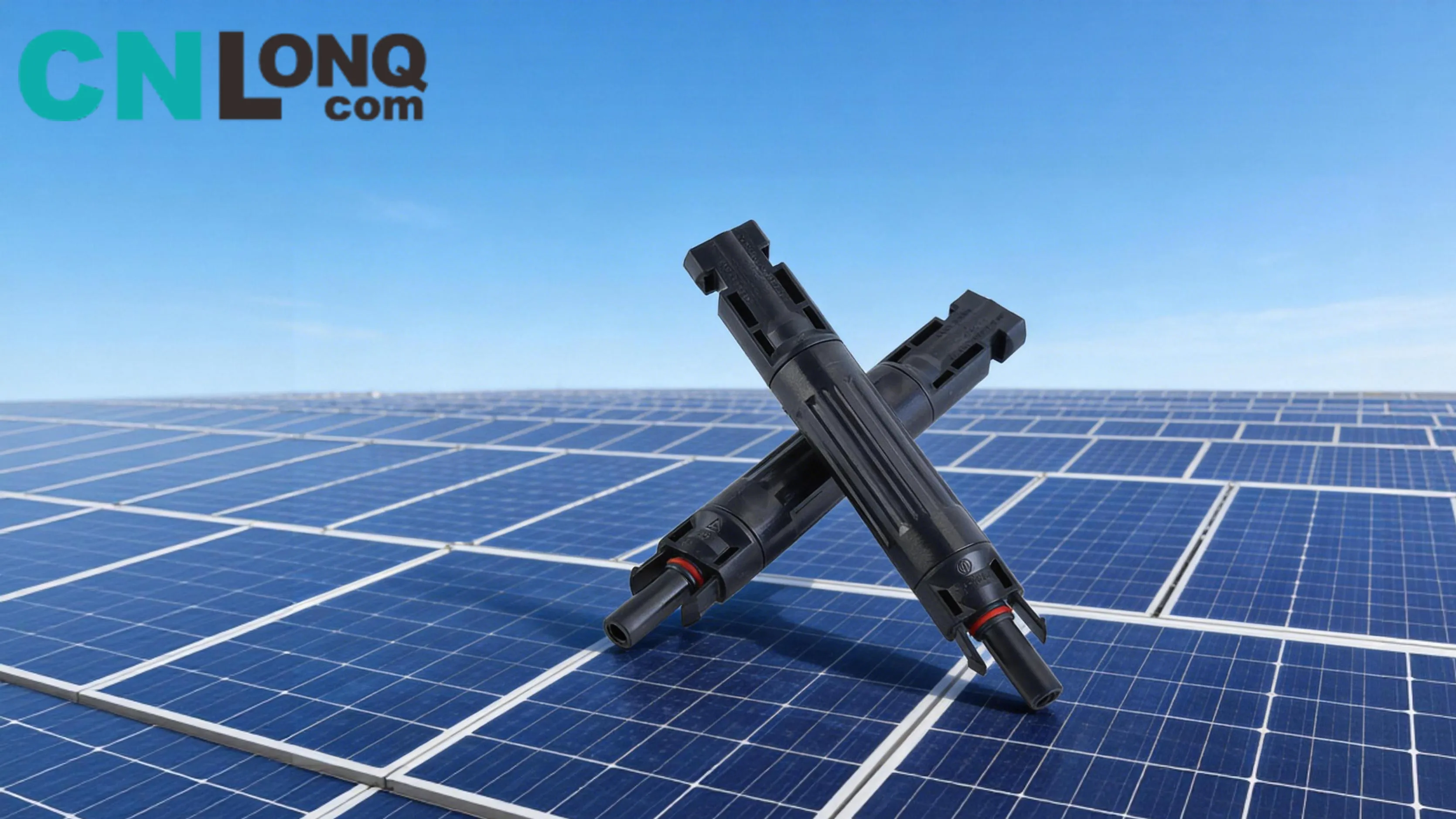
The MC4 is the most widely used PV connector in the world and has almost become synonymous with the industry.
Core advantages: The MC4 truly offers "plug-and-play" functionality for easy installation; uses MULTILAM technology to ensure long-term contact stability; insulating materials are hard plastics (PC/PA) with strong weather resistance; features a positive locking mechanism that meets NEC safety requirements.
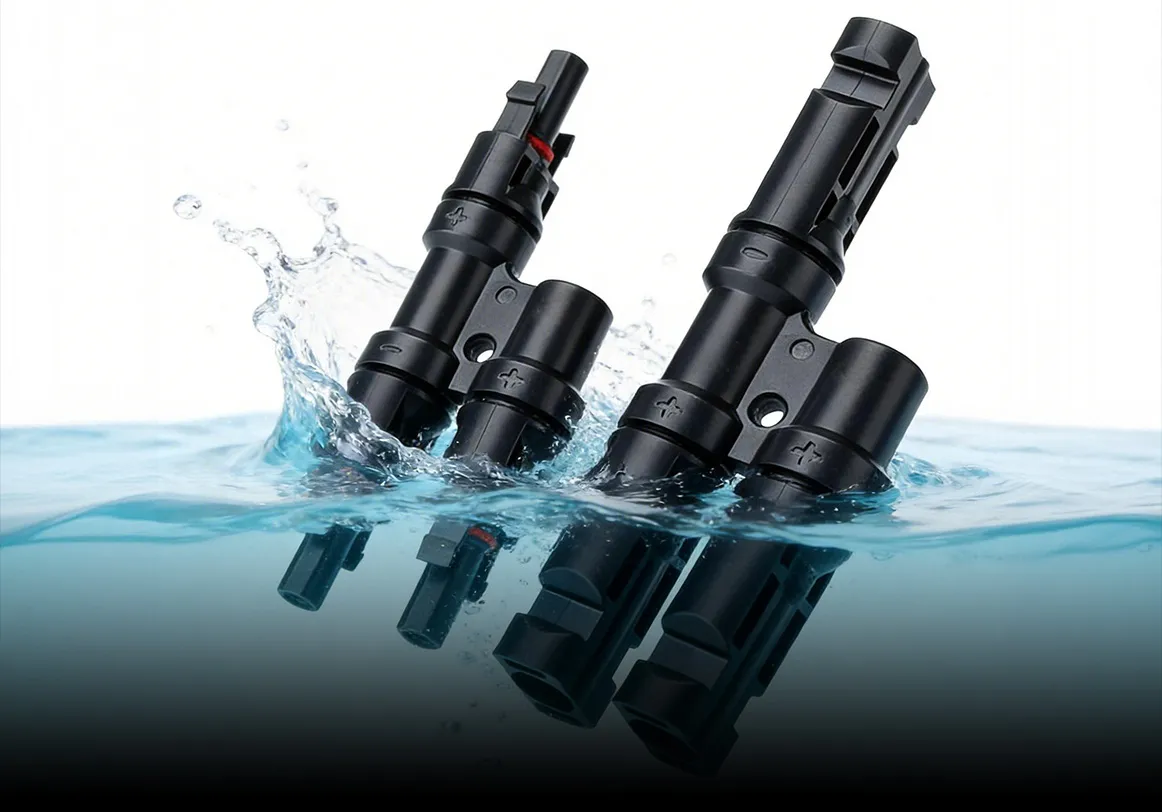
T-series connectors are mainly used for branch connection scenarios, allowing parallel connections between different PV panels. When expanding system capacity or optimizing layout, T-series connectors simplify installation, reduce overall system costs, and maintain efficient energy transmission. Structurally, a T-series connector creates a branch from the main line, forming a "T" shape, suitable for tapping off from the main circuit.
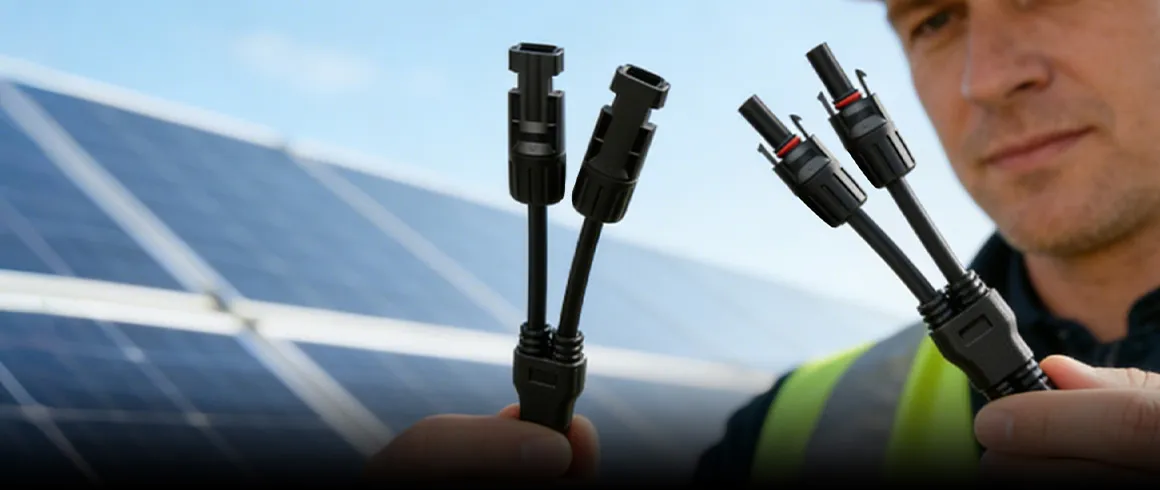
Y-series connectors are another branch connection solution, offering three-way or multi-way connection functions to integrate more PV panels or components into an existing system.
Main types include: 2-to-1 (combines 2 strings into 1), 3-to-1 (combines 3 strings into 1), 4-to-1 (combines 4 strings into 1), as well as cross-type and T-type special structures.
Typical technical specifications: Rated voltage of 1000V or 1500V DC, rated current around 30A, protection degree IP68, contact resistance ≤0.35mΩ, flame retardancy rating UL94-V0, suitable for 4mm² or 6mm² cables. Y-series connectors use a self-locking system and multi-point connection design to ensure stable and reliable connections, making them particularly suitable for combining multiple strings in large-scale PV power plants.
- Other Common Types
In addition to the three main types above, there are also board-end MC4 connectors (directly connecting to PV panels, compact and waterproof, used at PV module junction box outlets), cable-end MC4 connectors (connecting cables with excellent electrical insulation, used for transmission from panels to inverters), high-voltage connectors (suitable for 1500V and above systems, used in large ground-mounted power plants), and AC connectors (used on the AC side of inverters for grid connection).
Part 3: How to choose the right PV connector for your solar panel system?
Four Key Selection Factors
First, voltage matching. PV string voltages are trending toward 1500V. You must ensure the connector's rated voltage is greater than or equal to the system's maximum open-circuit voltage (considering voltage increase at low temperatures). A 1500V system must use a connector clearly rated for 1500V DC; never derate an under-specified connector for higher voltage use.
Second, current capacity. A margin of about 20% should be reserved. For example, if the string operating current is 15A, a connector with a rated current of at least 20A is recommended. Large combiner scenarios may require 50A or higher ratings.
Third, contact resistance. The contact resistance of a high-quality connector should be less than or equal to 0.5mΩ. Standard IEC62852 specifies that after mating, the contact resistance increase should not exceed 5mΩ, or the final resistance value should be less than 150% of the initial value. Excessive contact resistance causes severe heating, which can reduce power generation efficiency at best and cause fires at worst.
Fourth, protection degree. For outdoor installations, choose a protection degree of IP67 or higher to ensure protection against heavy rain, dust, and salt mist. In coastal or high-humidity areas, pay extra attention to corrosion resistance.
Critical Safety Principle
Always use connectors of the same brand and the same model for mating. Although "MC4-like" products from different manufacturers may look similar, their dimensional tolerances differ. Forcing mismatched connectors to mate can lead to increased and unstable contact resistance, temperature rise, reduced sealing (IP rating cannot be guaranteed), and in severe cases, fire. Industry organizations such as TÜV and UL have explicitly prohibited the cross-mating of connectors from different manufacturers.
Selection Checklist
When selecting a connector, we recommend verifying the following items one by one: Is the rated voltage greater than or equal to the system's maximum open-circuit voltage (1000V or 1500V)? Is the rated current at least 1.2 times the maximum operating current? Is the contact resistance ≤0.5mΩ? Is the protection degree IP67 or IP68? Has it passed certifications such as IEC 62852, UL 6703, or TÜV? Is the same brand and model being used for both mating ends? Will professional crimping tools be used for installation? Does the operating temperature range cover -40℃ to 90℃ to suit outdoor environments?
Summary
Although small in size, PV connectors are one of the most numerous and highest-risk components in a PV system. From the industry-standard MC4 connector to branch and combining solutions like the T-series and Y-series, selecting the correct connector type and parameters is critical. Following the core principles of "voltage matching, ample current capacity, same-brand mating, and professional tool installation" allows these quietly hardworking "small components" to play their "big role" over a 25-year lifespan, ensuring the safe and efficient operation of your solar power plant.
