English
 Español
 Deutsch
 Français
 عربي
عربي
PV Isolator Switch | Complete Guide: Basics, Selection, Installation & Safety Instructions
Date:8/14/2026 10:42:31 AM Click:209
In photovoltaic and energy storage systems, the DC isolator switch serves as a critical safety component. It is responsible for power cut-off during system maintenance and emergency isolation during faults, fully protecting equipment and on-site personnel. Specialized in PV DC power distribution, CNLONQ launches the DC1000V 32A PV isolator switch, ideal for residential rooftop PV, commercial & industrial solar systems, outdoor portable PV setups, RV solar power and small-scale ground power stations. This full guide covers product basics, parameter selection, standard installation and safety precautions, helping global distributors, engineers and installers master product application quickly.
1. PV Isolator Switch Basic Knowledge
1.1 What Is a PV DC Isolator Switch
A PV DC isolator is a manual disconnect device specially designed for solar DC circuits. It provides a visible physical isolation breakpoint, which is fundamentally different from ordinary AC switches. DC current has no zero-crossing point and is prone to strong electric arcs during disconnection. Ordinary AC switches cannot extinguish DC arcs and are strictly prohibited for PV DC systems.
Core functions of CNLONQ PV isolator:
1. Completely cut off the DC circuit between PV arrays, inverters and junction boxes for safe maintenance;
2. Isolate PV power supply rapidly in case of system faults to avoid arc ignition and fire risks;
3. Support lockable OFF position to comply with LOTO (Lockout/Tagout) safety standards and prevent accidental switch-on.
Note: The PV isolator has no overload or short-circuit protection. It must be used with DC fuses or DC circuit breakers for full system protection.
1.2 CNLONQ PV Isolator Product Overview
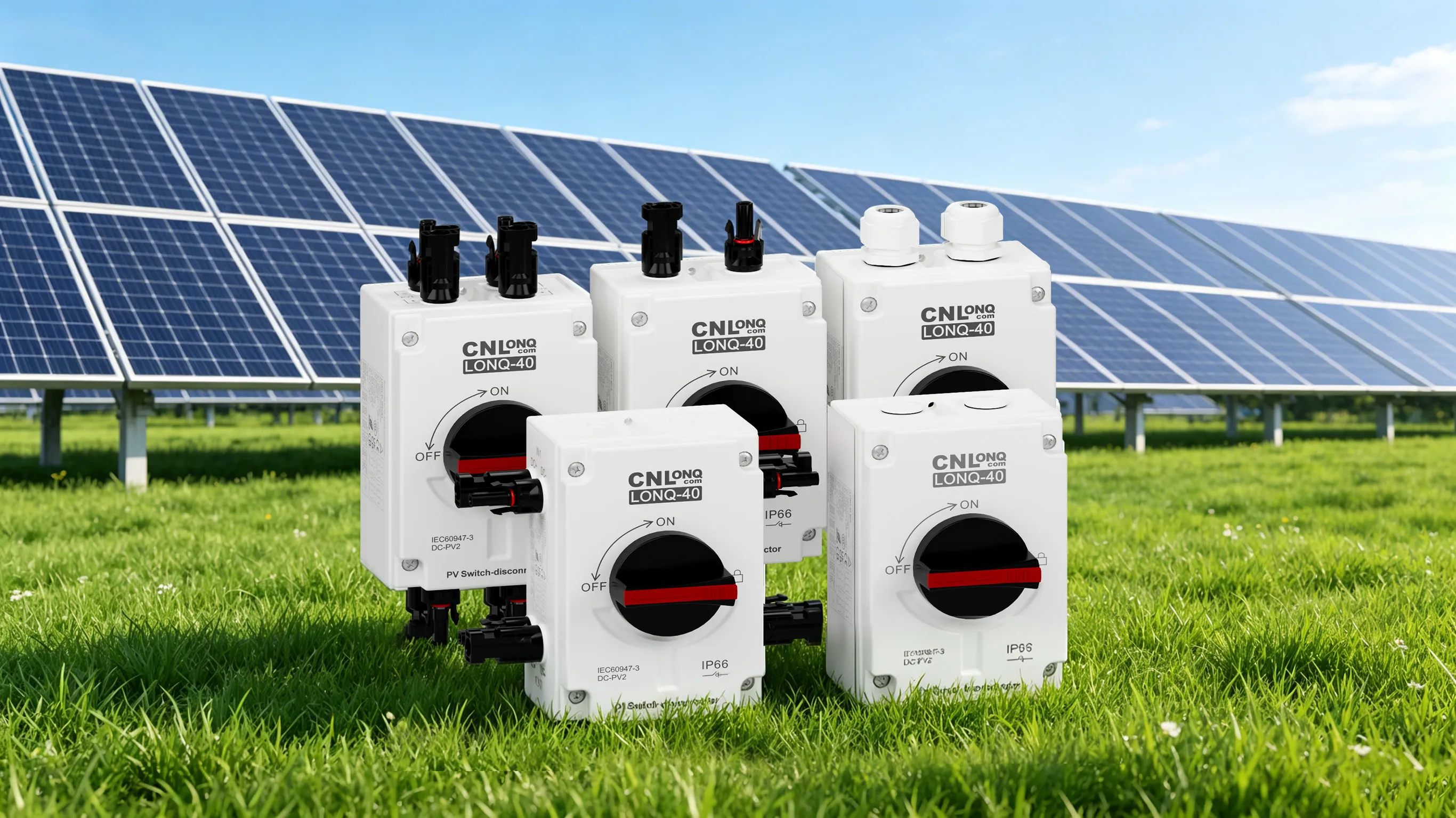
CNLONQ PV isolator adopts fixed standard specification: DC1000V 32A, available in two types: DIN rail indoor type and IP65 waterproof outdoor box type.
- Housing Material: High-quality PC ABS engineering plastic, UL94-V0 flame retardant, UV-resistant, anti-aging and high/low temperature resistant;
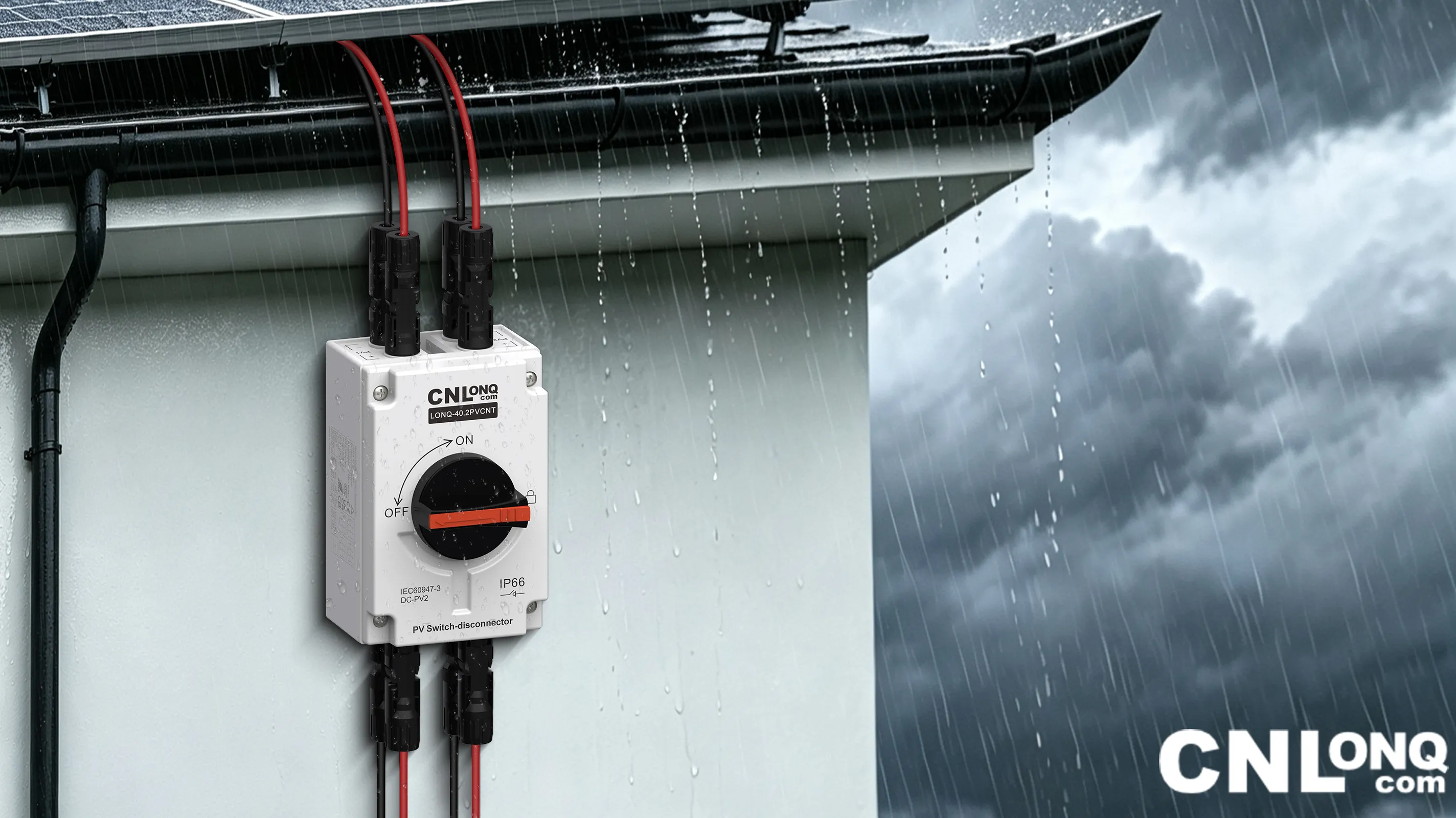
- Protection Grade: Outdoor version reaches IP65, fully dustproof and waterproof, suitable for rooftops, deserts, coastal salt-fog and other harsh outdoor environments;
- Arc Extinction Structure: Built-in professional DC arc extinction chamber for safe and stable DC breaking; reverse polarity tolerant design allows positive/negative reverse connection without affecting normal operation;
- Standard Compliance: Manufactured in accordance with IEC60947-3 international standards, widely compatible with junction boxes, solar inverters and RV solar energy systems for global PV projects.
1.3 Typical Installation Positions
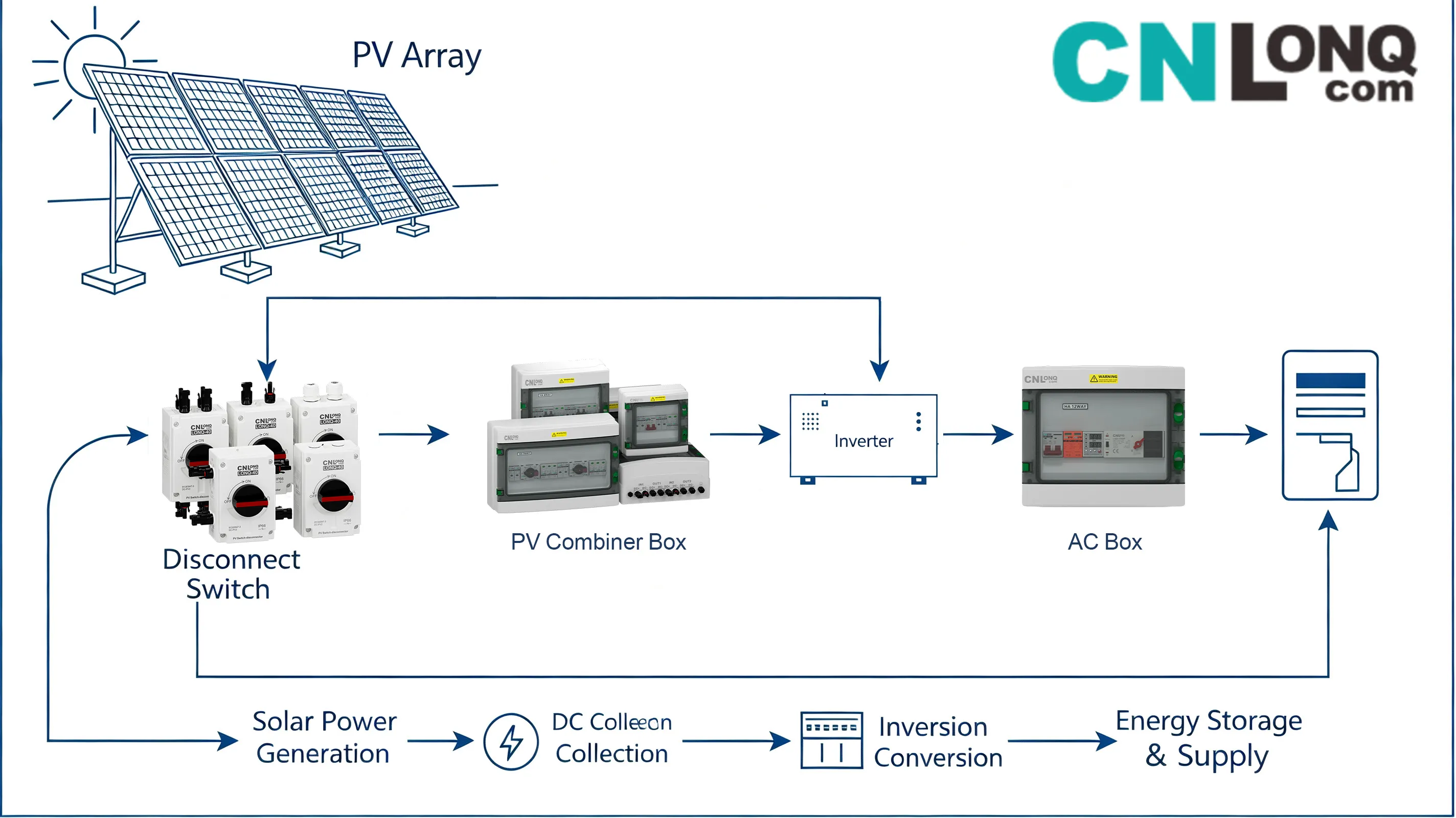
1. Output terminal of PV junction boxes;
2. DC input front end of solar inverters;
3. Tail end of PV string circuits;
4. Between solar panels and batteries of RV & portable PV systems.
2. Professional Selection Guide for CNLONQ PV Isolator
Core selection principles: Ensure voltage margin, reserve current tolerance, match environmental protection level, confirm pole number and verify certification.
Product fixed specification: DC1000V / 32A. Users only need to confirm whether the on-site working conditions match this specification.
2.1 Confirm Maximum System DC Voltage
PV module open-circuit voltage will rise significantly under low-temperature conditions. This isolator is rated DC1000V, which means the maximum low-temperature open-circuit voltage of the entire PV system must not exceed 1000V.
- Residential small string systems: Most household PV arrays are fully compatible;
- Long-string commercial & industrial systems: Not applicable if the low-temperature open-circuit voltage exceeds DC1000V.
Important: Do not select according to the module working voltage. Always calculate based on low-temperature open-circuit voltage.
2.2 Verify Circuit Working Current
The rated continuous current is 32A. Considering current derating caused by high temperature and enclosed installation environment, the long-term working current of the circuit is recommended not to exceed 24-25A (25% safety margin reserved).
Example: If the maximum working current of a single PV string is 13A, the total aggregated current of multiple strings shall not exceed 25A to avoid overheating and aging of the switch.
Caution: Do not use this 32A isolator if the continuous circuit current exceeds 25A.
2.3 Select Pole Number
- 2P (2 Pole): Standard for most PV grid-tied and energy storage systems, disconnects both positive and negative poles simultaneously;
- 4P (4 Pole): Suitable for multi-string centralized convergence scenarios, supports dual-circuit synchronous isolation.
Recommendation: 2P model is the preferred choice for most residential and standard commercial PV projects.
2.4 Match Installation Environment & Protection Level
1. Indoor installation (distribution cabinet / junction box): Adopt DIN35 rail mounting type, compact size, easy and firm installation;
2. Outdoor installation (rooftop / wall / RV exterior): Must choose IP65 waterproof box type. The UV-proof plastic housing provides excellent waterproof, dustproof and anti-aging performance for long-term outdoor operation.
2.5 Check Certification & Functional Features
1. Compliant with IEC60947-3 international PV electrical standards; UL/TUV certification documents are available for overseas export projects;
2. Lockable handle design supports LOTO safety management to prevent accidental closing;
3. Reverse polarity tolerant design improves wiring fault tolerance for RV and portable PV scenarios.
2.6 Selection Avoidance Tips
❌ Do not replace DC isolator with ordinary AC switch;
❌ Do not use if system maximum open-circuit voltage is higher than DC1000V;
❌ Do not overload the switch with circuit current close to or over 32A;
❌ Do not expose indoor rail-type switches directly outdoors without waterproof housing;
✅ Selection Rule: System voltage ≤ DC1000V, sufficient current margin, IP65 for outdoor use, dedicated for DC PV systems.
3. CNLONQ PV Isolator Standard Installation Guide
⚠️ Critical Safety Rule: PV arrays generate high-voltage DC power under sunlight. Always cover all PV modules to cut off power before wiring. Never work with live circuits!
3.1 Pre-installation Preparation
Tools required: Cross screwdriver, torque wrench, PV dedicated DC cable, cable gland, cable tie, insulating tape.
Inspection: Confirm the product model is DC1000V 32A, housing is intact, and the handle operates smoothly without jamming.
3.2 Installation Methods
1. DIN Rail Indoor Type
Align the switch buckle with the standard 35mm DIN rail, press down firmly to fix, and confirm no looseness. Install inside junction boxes or inverter DC compartments.
2. IP65 Waterproof Outdoor Wall-mounted Type
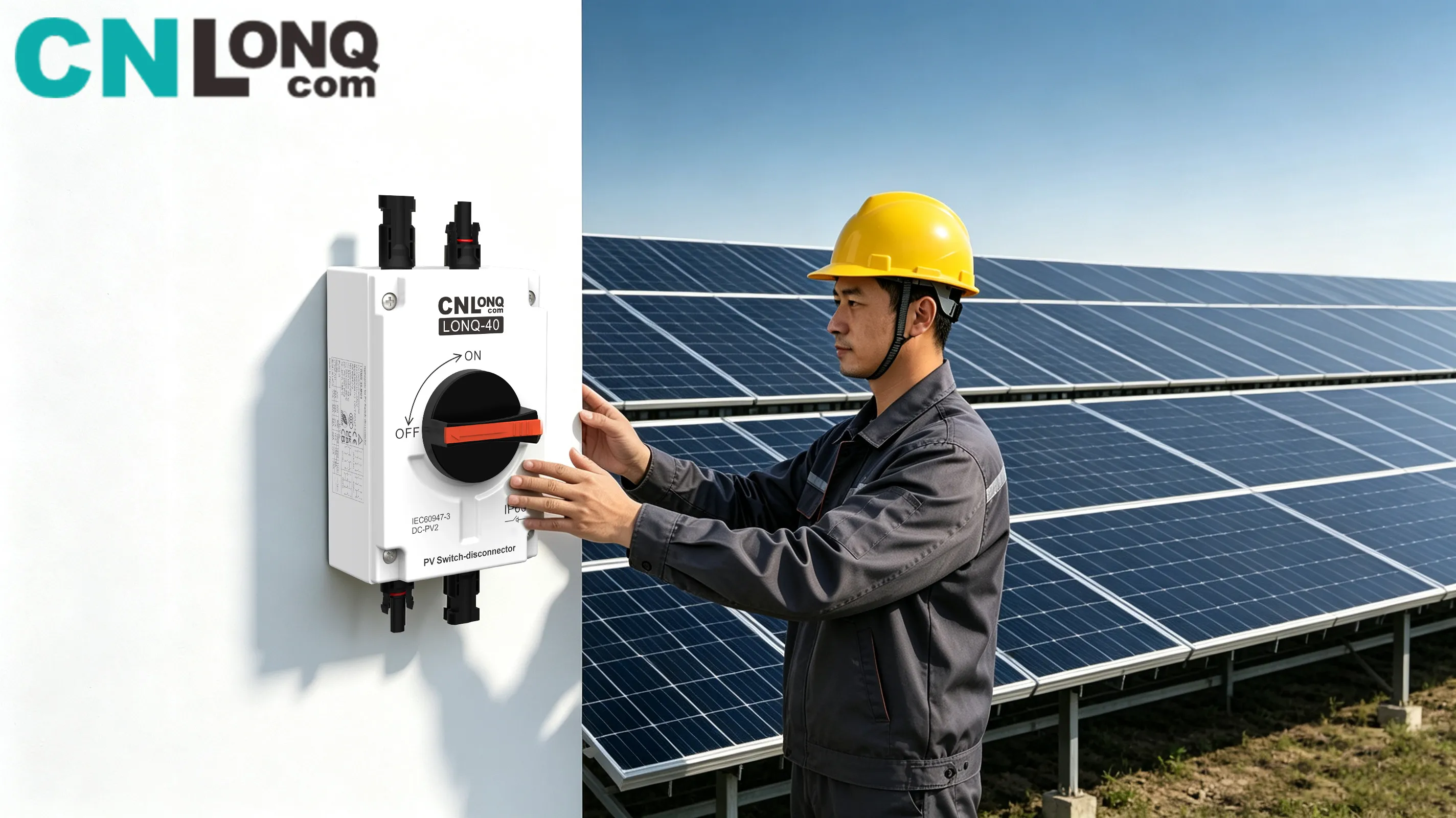
Remove the rear cover, fix the box on the wall or bracket with expansion screws, and reserve convenient operation space for the handle. Avoid long-term direct sunlight to prevent overheating. Lead cables in from side cable glands only. Never drill holes on the top of the box to avoid rainwater ingress.
3.3 Standard Wiring Specifications
1. Adopt professional PV DC cables. For 32A models, 4-6mm² cable size is strictly recommended;
2. Strip the cable insulation properly, crimp copper terminals completely, and avoid exposed loose copper wires to prevent virtual connection and arcing;
3. Distinguish PV array input (IN) and equipment output (OUT, connected to inverter/junction box). The switch supports reverse polarity connection, but standard wiring per marking is recommended for standardized construction;
4. Tighten terminal screws with a torque wrench per official specifications to prevent loose terminals from causing overheating and burnout;
5. Lay DC cables independently. Do not lay DC and AC cables in the same pipe to avoid signal interference and safety hazards;
6. Tighten all outdoor cable glands after wiring to ensure full sealing and prevent moisture and rainwater from entering the housing.
3.4 Post-installation Debugging Steps
1. Recheck all terminals for firm connection and remove residual copper debris inside the box;
2. Keep the switch in OFF state, then restore PV module lighting;
3. Test input terminal DC voltage to ensure no more than DC1000V;
4. Switch ON slowly, check for abnormal noise or overheating, and confirm normal output voltage and circuit conduction;
5. Operate the switch 3-5 times continuously to ensure smooth switching and clear ON/OFF indication;
6. Paste PV DC power warning labels on the outer box for safety identification.
4. Operation & Maintenance Safety Precautions
4.1 Safety Operation Rules
1. No live switching operation: Operate the switch under low light conditions as much as possible. Although the product supports slight live load breaking, frequent live switching will accelerate contact wear and shorten service life;
2. Ensure the handle fully displays ON/OFF status without jamming. Keep the switch in OFF position and lock it during maintenance to implement LOTO safety procedures;
3. Reserve sufficient heat dissipation space around the switch. Do not wrap the housing with cables or sundries to avoid poor heat dissipation and current derating;
4. Current derating is required for high-altitude and high-temperature environments to ensure safe operating current.
4.2 Daily Maintenance & Inspection
1. Regular visual inspection: Check outdoor housings for cracks, aging seals and water ingress at cable glands;
2. Temperature inspection during full-load operation: If abnormal overheating occurs, cut off power immediately to check loose terminals or over-current problems;
3. Operation inspection: The handle shall operate smoothly and crisply. Replace the switch timely if stuck or loose;
4. Retighten all wiring terminals every 1-2 years;
5. Immediately power off and replace the switch if arcing, burning smell or abnormal conditions occur. Never continue using faulty equipment.
4.3 Common Faults & Troubleshooting
1. Switch overheating: Loose terminals, insufficient cable gauge or excessive operating current;
2. No power after switch-on: Virtual wiring connection or internal contact burnout;
3. Water condensation/ingress in outdoor box: Poor gland sealing or incorrect top wiring hole drilling; replace sealing accessories and adjust wiring mode.
5. Application Scenarios Summary
CNLONQ DC1000V 32A PV isolator switch is perfectly applicable for PV systems with maximum open-circuit voltage ≤1000V and continuous working current ≤25A. It is widely used in residential rooftop solar, medium and small commercial distributed PV stations, RV portable solar systems, and energy storage machine DC isolation units. Strict parameter matching, standardized installation and regular maintenance ensure long-term stable and safe operation of the entire PV power system.