English
 Español
 Deutsch
 Français
 عربي
عربي
How does a solar combiner box work
- What is a solar combiner box?
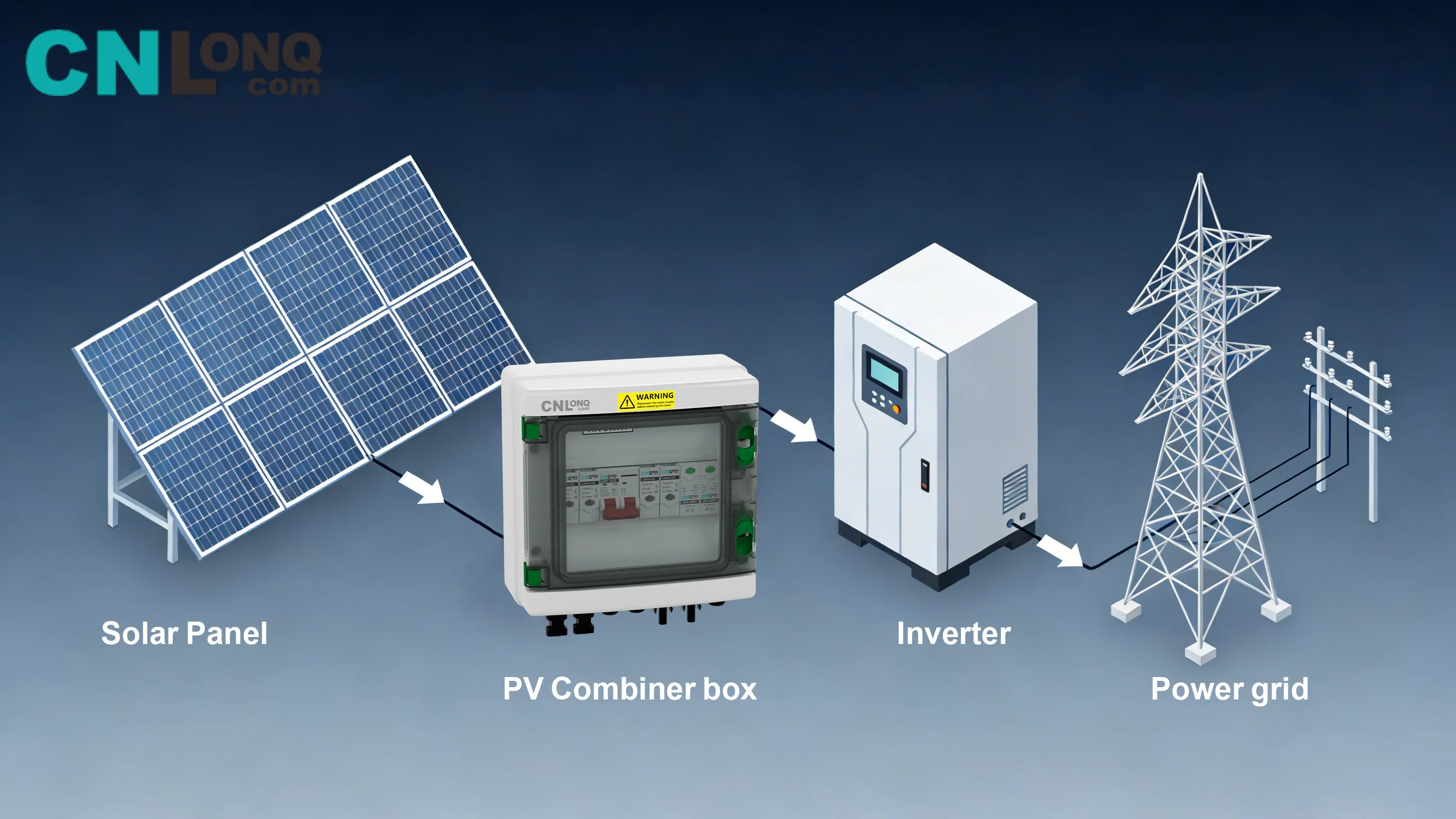
PV modules are basic power-generating units. In actual power stations, multiple modules are connected in series to form PV strings. A typical PV system can have dozens or even hundreds of strings.If every string were directly wired to the inverter, the system would become complicated, costly, difficult to protect, and inconvenient to maintain.
Main functions of a solar combiner box:
Combine currents from multiple strings into one or several outputs.
Provide independent protection for each string against short circuit, overcurrent, and reverse current.
Offer safety features such as lightning protection, insulation monitoring, and real-time status monitoring.
Simplify wiring, reduce power loss, and facilitate later operation and maintenance.
In short: Protect first, combine then, output finally — safe and efficient.
- Working principle of a solar combiner box
① Current Input: Multiple PV strings connected
Each PV string generates DC power under sunlight, with positive and negative poles connected to independent input terminals of the combiner box.Common configurations: 1 to 24 strings.
② String Protection: Independent safety protection for each circuit
This is the most critical protection mechanism:
DC fuse / circuit breaker: Quickly disconnects the faulty string during short circuit or overcurrent, without affecting the normal operation of other strings.
Anti-reverse diode: Prevents current backflow to modules at night or when a string is shaded or faulty, avoiding overheating and damage to modules.
③ Main Circuit Protection & Lightning Protection
Main DC circuit breaker: Provides overall protection for the combiner box output and allows safe power-off during maintenance.
Surge Protective Device (SPD): Discharges high-voltage surges caused by lightning or grid fluctuations to the ground, protecting modules, combiner box, and inverter from breakdown.
④ Intelligent Monitoring (for smart combiner boxes)
High-end combiner boxes are equipped with intelligent monitoring modules that:
Collect real-time data: string current, total voltage, cabinet temperature, insulation status.
Automatically alarm for faults: string disconnection, fuse failure, insulation degradation, lightning protection failure.
Upload data to the monitoring platform for remote O&M and quick fault location.
⑤ Output to Inverter
The protected and combined DC power is transmitted to the PV inverter, which converts it into AC power for grid connection or on-site load use.
- Product Advantages: Protection, Material & Reliability
This solar combiner box features excellent environmental adaptability and high‑level safety performance.With an IP66 ingress protection rating, it effectively prevents dust ingress and powerful water jet intrusion, suitable for long‑term outdoor installation.
The enclosure is made of PA engineering material, featuring high strength, toughness, and impact resistance. It also provides outstanding flame‑retardant performance, suppressing combustion and reducing risks under high temperatures or accidental fire.
The combiner box operates stably over a wide temperature range, with excellent resistance to high and low temperatures, aging, and ultraviolet radiation. It withstands outdoor harsh conditions including strong sunlight, rain, cold, wind, and sand, remaining deformation‑free, crack‑free, and durable for long‑term use.
To ensure global quality compliance, the combiner box has passed multiple international certifications, including CE, IOS,RoHS, TUV, fully meeting international safety and performance standards. Its protection level can reach IP66–IP67, with outstanding performance in waterproofing, dustproofing, insulation, and flame resistance.Verified from material, structure to electrical safety, it is safe, stable, and highly reliable — an ideal solution for DC distribution and protection in PV power systems.
- Summary
A solar combiner box first provides overcurrent, reverse‑current, and lightning protection for each PV string, then safely combines multiple currents, and stably outputs power to the inverter.It is an indispensable safety hub on the DC side of PV systems.
- Core Value
Simplified system: Reduces cabling, lower construction and material costs.
High safety: Independent string protection, fault isolation, lightning and leakage protection.
Easy maintenance: Intelligent monitoring for fast fault location.
Improved efficiency: Reduces power loss and ensures stable system operation.