 English
 Español
 Deutsch
 Français
 عربي
عربي
More Than an Upgrade—Redefining Safety: A Comprehensive Comparison of the New LD3-40PV vs. the Legacy LD1-40PV Photovoltaic Surge Protective Devices
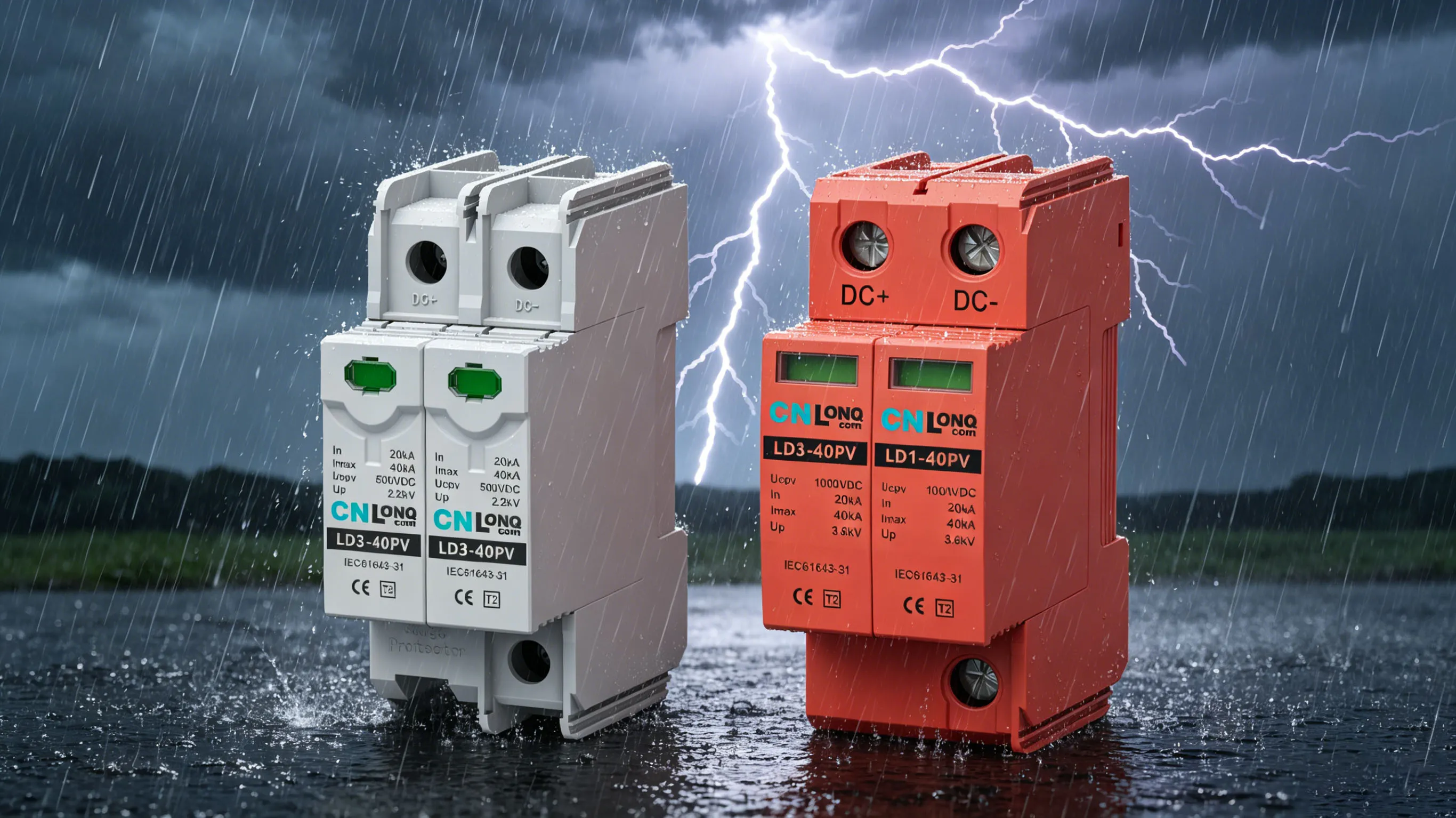
Housing Material: PBT Engineering Plastic vs. PA Plastic—Weather Resistance Determines Longevity
The housing material is the first line of defense for long-term SPD reliability. PV systems are exposed outdoors for decades, enduring UV radiation, temperature extremes, and moisture—all of which accelerate material aging.
The LD1-40PV uses standard PA plastic (nylon). While PA offers light weight, high strength, and good mechanical properties, it has inherent weaknesses: poor UV resistance and susceptibility to outdoor aging over extended periods. In the high-temperature, high-humidity environments typical of PV installations, the long-term reliability of PA plastic is a concern.
The LD3-40PV upgrades to premium PBT engineering plastic. PBT delivers excellent stain resistance, high toughness, superior electrical insulation, and enhanced UV protection. With a continuous operating temperature tolerance of up to 80°C—outperforming PA—PBT also maintains outstanding electrical properties under high-temperature and high-humidity conditions, a clear advantage over PA and many other reinforced plastics. This means the LD3-40PV resists cracking, maintains stable insulation, and offers superior long-term reliability in outdoor, sun-exposed PV environments.
Flame Retardancy: UL94 V-0 vs. V-1—The Highest Safety Standard
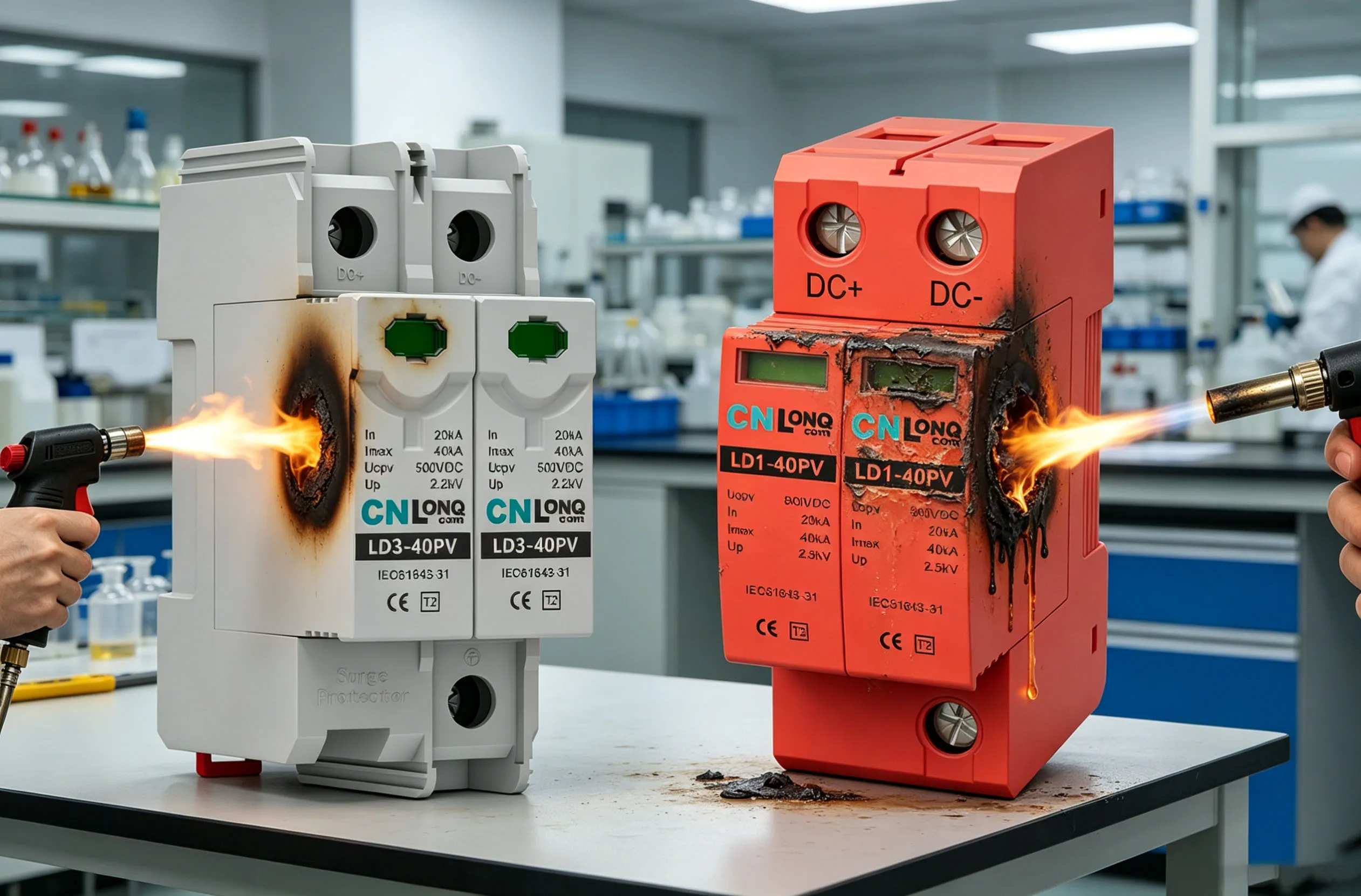
Flame-retardant ratings are a lifeline for electrical safety, especially in PV DC systems where arcing and high temperatures are potential risks.
The LD1-40PV is rated UL94 V-1, while the LD3-40PV achieves UL94 V-0. Per UL94 standards, the key difference: V-0 requires afterflame time ≤ 10 seconds per specimen, while V-1 allows ≤ 30 seconds. In short, V-0 means "self-extinguishes immediately upon flame removal", with self-extinction speeds three times faster than V-1—the highest flame-retardant classification in vertical burning tests. For PV systems, where fire damage can be catastrophic, V-0 rating minimizes the risk of the SPD itself becoming an ignition source under abnormal conditions.
Arc Shield Design: Optional vs. Not Available—A Critical Barrier Against Arc Flash Ignition
This represents the most significant difference in active safety protection between the two models.
The LD3-40PV supports an optional arc shield, while the LD1-40PV does not. Under short-circuit conditions, the arc shield plays a vital role: containing arc efflux and preventing arc flash ignition. When an SPD trips due to lightning surges or internal faults, arcing can occur between the varistor and the trip mechanism in air. Industry practice shows that a large arc-shield design enables rapid heat transfer from low-temperature solder joints and provides a creepage distance of >10 mm after tripping, effectively preventing fire risk. In contrast, conventional designs offer only about 3.8 mm of creepage, significantly increasing the likelihood of short-circuit-induced fires.
The arc shield effectively adds a physical fire barrier to the PV system, substantially enhancing lightning protection safety.
Terminal Material: Phosphor Bronze vs. Tin-Plated Copper—Superior Conductivity and Oxidation Resistance
Terminals are the critical junction for current transmission—material choice directly impacts conductivity and long-term stability.
The LD1-40PV uses tin-plated copper terminals, while the LD3-40PV upgrades to phosphor bronze terminals. Phosphor bronze (e.g., C5102) offers good conductivity (approximately 15–20% IACS) along with excellent elasticity, fatigue resistance, and corrosion resistance.
In contrast, tin-plated copper terminals, while acceptable initially, are prone to degradation of the plating layer over time due to oxidation and wear, leading to increased contact resistance. Over a PV system's 20 year service life, phosphor bronze terminals provide superior oxidation resistance and fatigue durability for more stable long-term performance.
Shared Core Technology: Shield Storm Lightning Protection Chip—The Common Foundation Across Both Generations
Both the LD3-40PV and LD1-40PV are built on the Shield Storm Lightning Protection Chip technology platform. Both models deliver instantaneous surge protection with a response time of ≤25 ns, capable of diverting overvoltage and lightning energy to ground in nanoseconds. This shared core technology underscores the brand's consistent lightning protection performance across both product lines.
Summary: Comprehensive Safety Evolution at a Glance
| Comparison Dimension | Legacy LD1-40PV | New LD3-40PV | Key Advantage |
|---|---|---|---|
| Housing Material | PA plastic (moisture-absorbent, poor UV resistance) | PBT engineering plastic (heat-resistant, UV-stable, superior insulation) | Extended outdoor lifespan, more stable electrical performance |
| Flame Retardancy | UL94 V-1 (afterflame ≤ 30s) | UL94 V-0 (afterflame ≤ 10s) | Highest-grade flame retardancy—self-extinguishes immediately |
| Arc Shield | Not available | Optional, contains arc efflux | Prevents arc flash ignition, multiplies safety margins |
| Terminal Material | Tin-plated copper (plating susceptible to aging) | Phosphor bronze (conductive oxidation-resistant fatigue-resistant) | More stable long-term operation |
Conclusion
The new LD3-40PV surge protective device is not merely a model iteration—it is a comprehensive safety evolution spanning material science, flame-retardant engineering, arc-flash protection, and conductive material selection. For PV systems that must withstand harsh outdoor conditions and deliver decades of reliable performance, the LD3-40PV addresses critical pain points head-on—using higher-grade materials and more robust safety designs to build a stronger defense for photovoltaic station surge protection.
