English
 Español
 Deutsch
 Français
 عربي
عربي
MC4 Connector Guide for Solar Panel Installation
Date:8/24/2026 9:42:49 AM Click:249
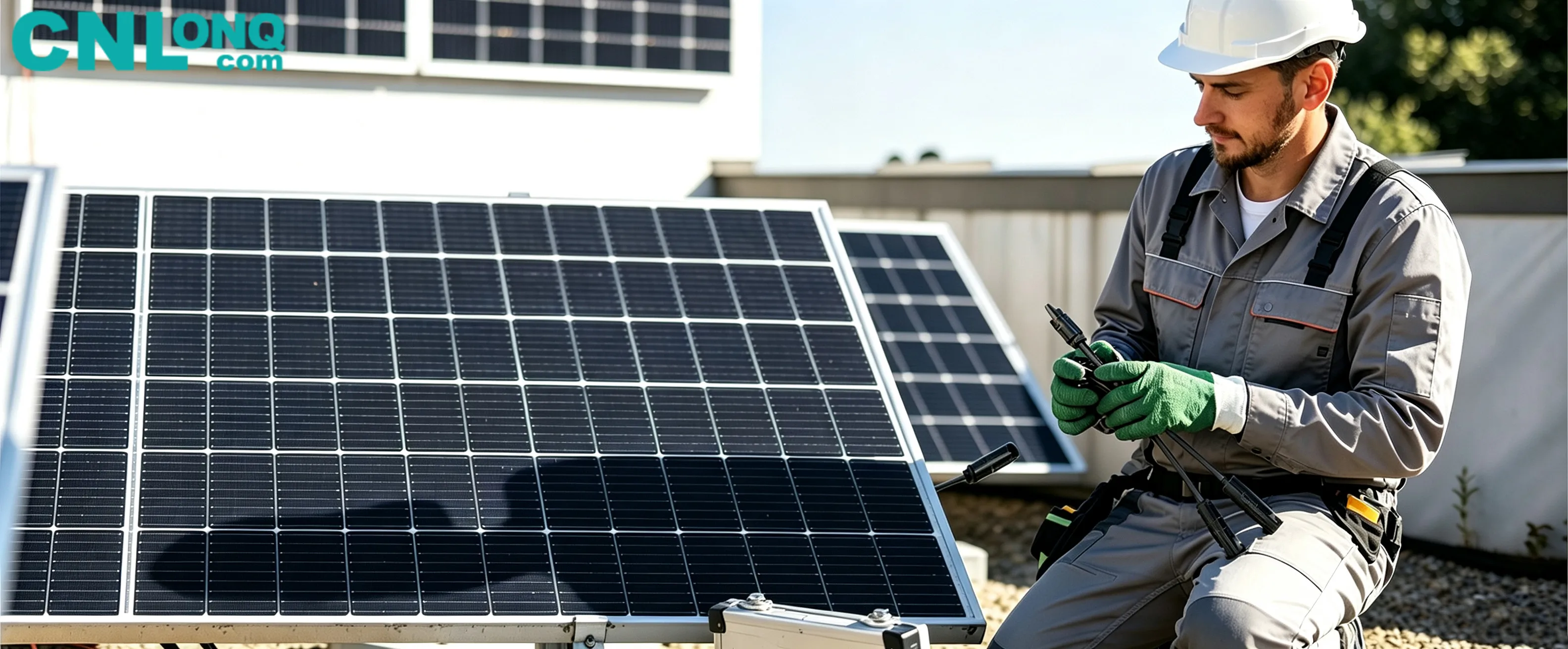
In photovoltaic (PV) system installation, stable, safe, and weatherproof cable connections directly determine the power generation efficiency and service life of solar power stations. As the most widely adopted standardized DC connection accessory for solar systems, MC4 connectors deliver reliable high-voltage and high-current performance, IP67 waterproof protection, and diversified functional designs. They perfectly fit residential, commercial, industrial, and large-scale ground solar power projects. This guide comprehensively introduces the definition, classified specifications, key applications, and frequently asked questions of MC4 connectors, providing professional references for solar product selection, on-site installation, and daily maintenance.
1. What Is an MC4 Connector?
The MC4 connector is a professional waterproof quick-lock plug connector dedicated to PV DC power systems and has become an industry-standard component for global solar installations. It is named after its 4mm standard contact pin structure. Featuring a male and female locking pairing design, MC4 connectors support anti-misplug, anti-drop locking, high and low temperature resistance, low contact resistance, and excellent anti-oxidation and anti-corrosion performance. They enable fast, secure, and stable electrical connections between solar panels, PV cables, inverters, junction boxes, and energy storage devices.
MC4 connectors adopt high-strength flame-retardant insulating shells and tin-plated copper internal contacts, ensuring excellent conductivity and low line loss. Equipped with premium waterproof rubber rings, they achieve all-weather outdoor protection. Covering full operating conditions from low-voltage residential systems to high-voltage utility-scale power stations, the diversified MC4 series meets various wiring requirements, including basic straight connection, overload protection, reverse current prevention, and multi-circuit shunting, making it an essential core accessory for all PV systems.
2. Types and Technical Specifications of MC4 Connectors
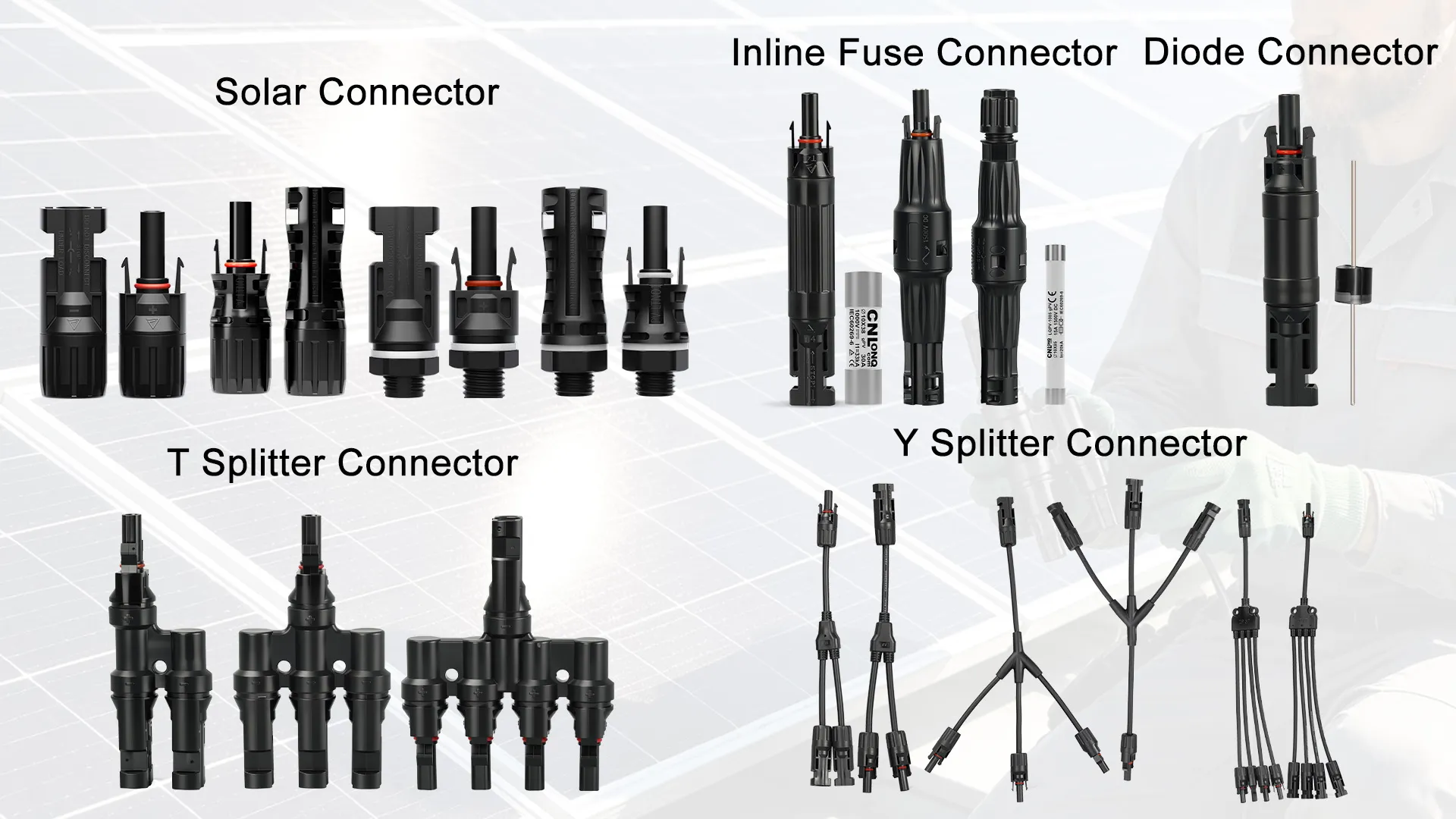
Based on different functional requirements for PV system wiring, circuit protection, and multi-line convergence, MC4 connectors are divided into five mainstream types with exclusive voltage, current, and structural parameters. The detailed introductions and specifications are as follows:
2.1 Solar Connector (Standard Straight Connector)
The standard straight MC4 connector features a one-to-one male-to-female docking structure with no built-in electronic components. It is the most fundamental and commonly used connector for extending and series-connecting PV cables and solar panels, serving as the standard configuration for basic PV wiring. Technical Specifications: Rated voltage: DC 1000/1500V; Rated current: 30A, 45A, 50A, 60A. With IP67 dustproof and waterproof ratings, this connector offers outstanding weather resistance, stable locking, convenient plugging, and ultra-low failure rates, fully compatible with most conventional solar panel series wiring scenarios.
2.2 Solar Inline Fuse Connector
This functional MC4 connector is designed with a built-in fuse holder for standard 10×38mm fuse links, providing dual functions of circuit connection and overcurrent/short-circuit protection. It effectively prevents circuit overheating, component burnout, and system damage caused by PV branch faults. Technical Specifications: Rated voltage: DC 1000/1500V; Rated current range: 1A to 32A. Boasting IP67 all-weather protection, it adapts to harsh outdoor environments. It is widely applied in commercial, industrial, and large-scale solar power stations with multiple series-parallel arrays to greatly improve overall system electrical safety.
2.3 Solar Inline Diode Connector
Integrated with a dedicated anti-reflux diode, this protective MC4 connector suppresses reverse current backflow in PV systems. It effectively avoids circulating current, electric leakage, and heat loss of solar panels caused by nighttime power backflow, cloudy weather, or partial panel shading, eliminating the need for external diode modules and simplifying system wiring. Technical Specifications: Rated voltage: DC 1000V; Rated current: 10A, 15A, 20A, 30A. Featuring IP67 waterproof and dustproof performance, it operates stably in humid, dusty, and high-temperature outdoor environments, ideal for residential and small-scale distributed PV systems to reduce reactive power loss and extend solar panel service life.
2.4 Solar Y Splitter Connector
The Y-type splitter connector adopts a multi-in-one convergence structure, which integrates multiple PV branch circuits into a single main circuit to simplify parallel wiring of solar arrays. Technical Specifications: Rated voltage: DC 1000V; Rated current: 30A, 45A, 50A; Available models: Y2, Y3, Y4 (2/3/4-to-1). With IP67 all-weather protection, it enables small-scale PV parallel convergence without additional junction boxes. It features low voltage drop and high stability, perfectly suited for residential and small commercial distributed solar parallel networking.
2.5 Solar T Splitter Connector
Different from Y-type converters, the T-type splitter adopts a one-out-multi branch structure, which divides a single main PV circuit into multiple independent branches. It is widely used for main line branching, scattered panel wiring, and solar system capacity expansion. Technical Specifications: Rated voltage: DC 1500V; Rated current: 50A; Available models: T2, T3, T4, T5, T6 (2/3/4/5/6-to-1). With high voltage resistance, balanced shunting performance, and IP67 rugged protection, it adapts to complex working conditions such as high-voltage distributed power stations, scattered rooftop solar installations, and old PV system renovation projects.
3. Main Applications of MC4 Connectors
Thanks to its full-coverage parameter range, complete functional categories, excellent weather resistance, and simple installation, the MC4 connector has become a universal standard accessory for the global PV industry. Its core application scenarios are listed below:
1. Residential Rooftop PV Systems: Standard straight MC4 connectors and 10–30A inline diode connectors are mainly used for solar panel series connection and reverse current prevention. Adapted to DC 1000V low-voltage operating conditions, they meet the basic connection and safety protection needs of household self-consumption solar power systems.
2. Small and Medium Commercial & Industrial PV Systems: Y-type splitter connectors are adopted for multi-panel parallel convergence, while inline fuse connectors (1A–32A) provide overcurrent protection for each branch. Matched with 30A/45A/50A current specifications according to system power, they stabilize the operation of medium and small-sized solar arrays and simplify wiring layouts to reduce circuit failure rates.
3. Large-Scale High-Voltage Solar Power Stations: DC 1500V high-voltage straight connectors and 50A T-type splitters are applied to high-voltage and high-current wiring. Cooperated with fuse connectors for circuit safety protection, they adapt to harsh outdoor environments such as mountains and deserts, supporting long-term high-load operation of utility-scale PV projects.
4. Portable and Special PV Equipment: Compact straight connectors and low-current diode connectors (10A–30A) are widely used in RV solar systems, portable solar panels, solar street lights, and small energy storage integrated devices, enabling fast plug-and-play connection and reliable anti-reflux protection.
5. PV System Renovation and Capacity Expansion: T-type multi-way splitter connectors are used for branch expansion and circuit upgrading of existing solar power stations without replacing the main cables, effectively reducing renovation costs and supporting the upgrade of outdated PV systems.
4. Frequently Asked Questions (FAQ) About MC4 Connectors
Q1: Can MC4 connectors with different voltage specifications be mixed and matched?
A: Mixing different voltage-grade connectors is strictly prohibited. Standard straight connectors and inline fuse connectors support both DC 1000V and DC 1500V. Inline diode connectors and Y-type splitters are only applicable to DC 1000V systems, while T-type splitters are specially designed for DC 1500V high-voltage systems. Using low-voltage connectors on high-voltage systems will cause insulation failure and high-voltage breakdown risks, while mismatched assembly will lead to potential safety hazards. Always select connectors according to the system’s rated voltage.
Q2: How to select the current rating for inline fuse connectors, and what fuse specifications are required?
A: The inline fuse connector is exclusively compatible with standard 10×38mm fuse links. The selection principle is to choose a fuse current slightly higher than the maximum operating current of the PV branch to avoid unnecessary fusing during normal power generation and ensure timely protection during faults. 10A/16A/20A fuses are suitable for small branches, while 25A/32A fuses are for medium and large branches. Do not exceed the 32A upper limit, otherwise the connector will overheat and fail to protect the circuit.
Q3: Why is the maximum current of diode connectors limited to 30A? Can they be used for high-power PV branches?
A: Inline diode connectors are specially designed for anti-reflux protection of small and single-string PV branches, with a maximum rated current of 30A. They cannot be used for high-power multi-series and parallel solar arrays. Exceeding the current limit will cause diode burnout and severe circuit overheating. For high-power systems, professional junction box anti-reflux modules are recommended instead of inline diode connectors.
Q4: What are the core differences between Y-splitter and T-splitter connectors?
A: In terms of specifications: Y-type splitters support DC 1000V and a maximum current of 50A, with 2/3/4-to-1 convergence options. T-type splitters support DC 1500V high voltage and 50A current, covering 2–6 way branching. In terms of functions: Y-type connectors converge multiple branch circuits into one main circuit for parallel panel connection; T-type connectors split one main circuit into multiple branches for line branching and system expansion. Select the appropriate type according to actual wiring needs.
Q5: Can MC4 connectors with different current ratings (30A/45A/50A/60A) be used interchangeably?
A: Interchangeable use is not allowed. Different current ratings correspond to different contact pin sizes, wire gauge compatibility, and current-carrying capacities. Using low-current connectors in high-current circuits will cause severe overheating, poor contact, arcing, and even burnout. Although high-current connectors can be temporarily used in low-power systems, they result in low cost performance and poor matching. Always select the exact current specification based on the maximum operating current of the circuit.
Q6: Do IP67-rated MC4 connectors require additional waterproof protection?
A: Qualified standard MC4 connectors feature official IP67 dustproof and waterproof ratings, capable of resisting rain, sand, dust, and temporary shallow water immersion. No extra waterproof tape or protective measures are required for standard outdoor installation. However, ensure the connectors are fully locked in place and the waterproof rubber rings are intact and undamaged. Loose connection or aging seals will cause water ingress, oxidation, electric leakage, and system failure.