English
 Español
 Deutsch
 Français
 عربي
عربي
What Is the Difference Between MCCB and MCB?
In low-voltage power distribution systems, circuit breakers are indispensable protective devices. However, many people's understanding of circuit breakers stops at the basic concept of "tripping protection," without realizing that different types of circuit breakers vary enormously in performance and application. The MCCB (Moulded Case Circuit Breaker) and the MCB (Miniature Circuit Breaker) both belong to the circuit breaker family, yet their roles are fundamentally distinct—one is a "heavy-duty solution" designed for industrial high-current scenarios, while the other is a "compact guardian" serving residential and lighting circuits.
- What Is an MCCB?
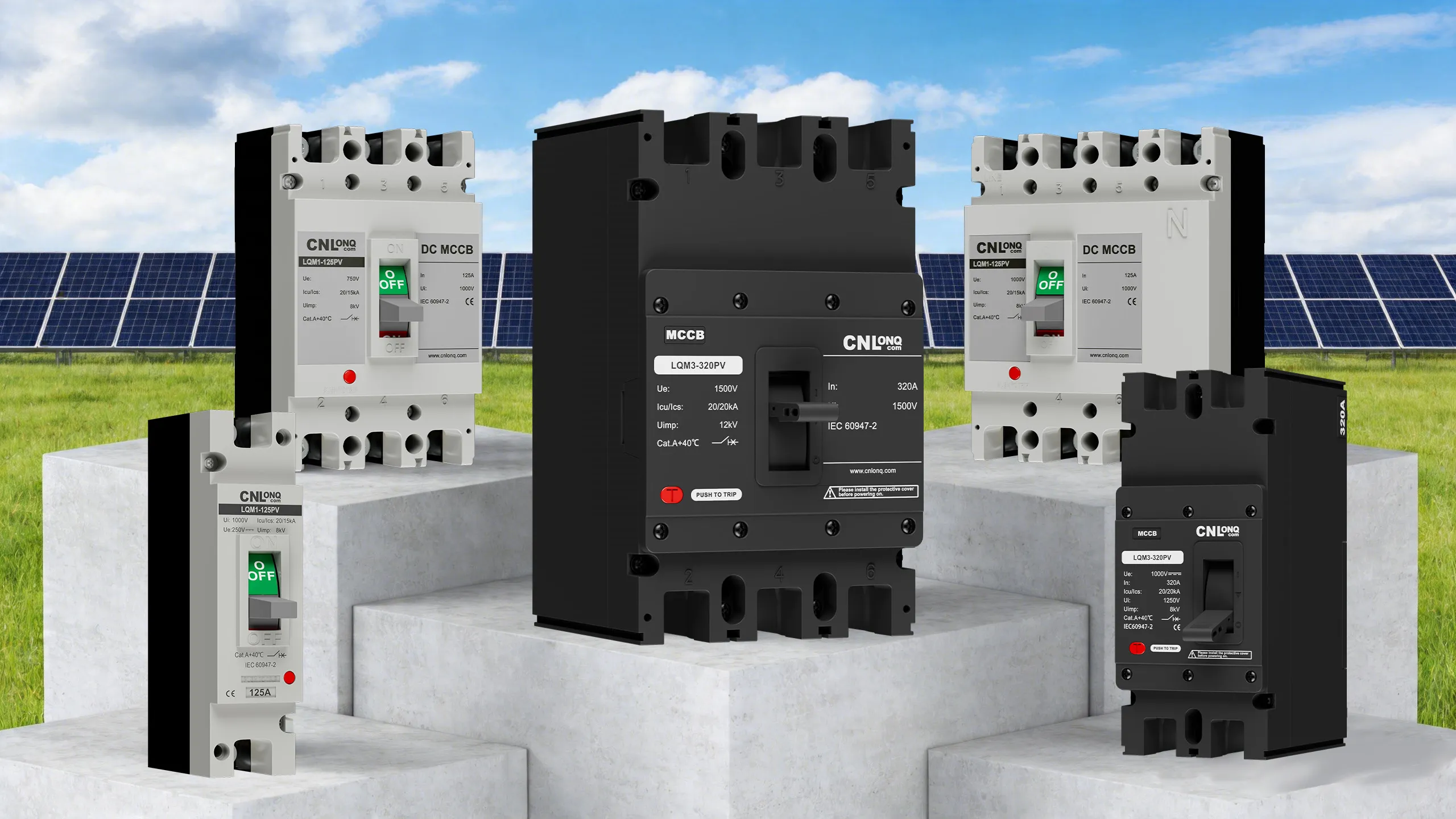
MCCB stands for Moulded Case Circuit Breaker. It is a protective device in which the contact system, arc extinguishing mechanism, and trip unit are all enclosed within an insulating plastic housing. The term "moulded case" derives from the housing being compression-molded from thermosetting resin or similar insulating materials, enabling it to withstand high-temperature arc impacts while meeting stringent insulation requirements.
The core function of an MCCB is feeder-level protection within low-voltage distribution systems. Typically installed in distribution cabinets, MCCBs perform the dual duties of power distribution and feeder circuit protection. When an overload or short circuit occurs, the MCCB reliably interrupts the fault current, preventing the incident from escalating.
MCCBs feature an extremely wide current range, with rated currents starting from 16 A and extending up to 1600 A or even 2000 A. Their breaking capacity—the ability to safely interrupt short-circuit currents—typically ranges from 18 kA to 200 kA, more than sufficient to handle the severe short-circuit stresses encountered in industrial environments. Furthermore, MCCB trip characteristics are generally adjustable: overload protection thresholds and short-circuit time delays can be flexibly set according to actual load conditions, enabling selective coordination with upstream circuit breakers.

- What Is an MCB (Ordinary Circuit Breaker)?
In electrical engineering contexts, the "ordinary circuit breaker" typically refers to the MCB—the Miniature Circuit Breaker. This is a compact, DIN rail-mounted protective device widely used in final distribution circuits.
The core function of an MCB is branch-circuit terminal protection. Installed at the final branch circuits within a distribution board, MCBs directly protect specific loads such as sockets, lighting, and household appliances. When a fault occurs on a particular circuit, only that MCB trips, leaving other circuits unaffected.
MCBs have relatively limited electrical parameters: the rated current generally does not exceed 125 A, with common ratings ranging from 6 A to 63 A. Breaking capacity is typically between 4.5 kA and 10 kA, with high-performance models reaching up to 15 kA. Their trip characteristics are factory-set and non-adjustable, categorized by application into B, C, and D curves—Type B for resistive lighting loads, Type C for general-purpose socket outlets, and Type D for loads with high inrush currents like motors. This "plug-and-play" design simplifies installation but also means MCBs lack the flexibility required for selective coordination.

III. Core Differences Between MCCB and MCB
3.1 Electrical Parameters: Orders of Magnitude in Capacity and Breaking Performance
This is the most fundamental distinction. Rated Current: The upper limit for MCBs is typically 125 A, with most applications below 63 A. MCCBs, on the other hand, span from 16 A to over 1600 A, easily accommodating the main feeder requirements of industrial plants.
The gap in breaking capacity is even more pronounced. MCB short-circuit breaking capacity typically ranges from 4.5 kA to 10 kA, adequate only for residential and light commercial environments. MCCB breaking capacity starts at 18 kA and can reach up to 200 kA for high-performance models, enabling them to safely interrupt severe short-circuit currents near large transformers or within industrial power grids.
Regarding voltage rating, MCBs are primarily applied in 230/400 V final circuits, whereas MCCBs can be rated for up to 690 V AC or higher industrial voltages, offering broader applicability.
3.2 Physical Size and Construction: Differences Apparent at a Glance
MCBs are characterized by their compact and lightweight design: a standard single-pole unit is only 18 mm wide, mounts on a standard 35 mm DIN rail via a snap-on mechanism, and accepts conductors up to 10 mm². This modular design occupies minimal space within distribution boards and facilitates easy replacement.
MCCBs are significantly larger: depending on the current rating, widths range from approximately 75 mm to over 300 mm, and weight can reach several kilograms. Installation is via screw fixation, requiring secure mounting onto the backplate of a distribution cabinet. Terminals are robust, capable of accommodating large cables of 35 mm² and above.
In terms of design philosophy, the MCB strives for "compact precision"—delivering essential protection within a minimal volume—while the MCCB embodies "robust strength"—its larger internal volume accommodates sophisticated arc chambers, adjustable trip mechanisms, and a wide array of accessories.
3.3 Trip Characteristics: Fixed vs. Adjustable Protection Logic
MCB trip characteristics are factory-preset and non-adjustable. For a typical Type C MCB, the magnetic trip threshold is fixed at 5–10 times the rated current—meaning the user cannot alter protection parameters based on actual load behavior. The advantage is simplicity and the elimination of field-setting errors, but this also restricts application in high-capacity or complex load scenarios.
MCCBs offer adjustable trip characteristics. Distribution-type MCCBs typically allow adjustment of the overload long-time delay threshold (Ir, usually 0.4–1.0 × In) and the short-circuit short-time delay threshold (Isd, usually 2–10 × Ir). This flexibility enables selective coordination: when a fault occurs downstream, only the circuit breaker closest to the fault operates, while upstream breakers remain closed, thereby minimizing the extent of a power outage. For industrial production lines, this capability is critical.
Additionally, MCBs combine overload and short-circuit protection within a single thermal-magnetic mechanism with relatively fixed timing. MCCBs can separate thermal overload and magnetic short-circuit protection functions; high-end models may employ electronic trip units for even more precise current-time protection curves.
3.4 Application Scenarios: From Residential to Industrial Roles
MCBs dominate in final branch circuits. Within a residential distribution board, virtually every circuit controlling lighting, sockets, or air conditioning is protected by an MCB. Commercial office workstations, retail shop displays, and similar distributed loads also rely heavily on MCBs for terminal protection. The defining characteristics are numerous circuits, modest currents, and standardized protection requirements.
MCCBs dominate in main feeders and industrial equipment protection. Within low-voltage distribution systems, MCCBs are typically deployed in the following roles:
Distribution Feeders: Serving as feeder switches that carry continuous currents of several hundred amperes.
Motor Protection: Motor-protection MCCBs are specifically designed to withstand starting inrush currents (typically 6–8 × In) without nuisance tripping.
Generator Outputs: Protecting generator sets from external short-circuit faults.
Transfer Switching Systems: Working in conjunction with Automatic Transfer Switches (ATS) to reliably switch between primary and backup power sources.
Typical Configuration Hierarchy: Main incoming supply uses an Air Circuit Breaker (ACB) or large-frame MCCB; sub-distribution circuits use small to medium frame MCCBs; final branch circuits use MCBs. This "graded protection" structure ensures both system safety and economical selective coordination.
- Selection Guide: Which Device for Which Scenario?
4.1 Scenarios Recommending MCCBs
Load current exceeds 125 A: This is the MCB's upper threshold. Once the circuit's rated current surpasses 125 A, MCBs are no longer an option; the MCCB becomes the only choice.
Selective coordination is required: In multi-tier distribution systems, the adjustable trip characteristics of MCCBs are essential for achieving proper time-current coordination between upstream and downstream devices. Relying solely on fixed-characteristic MCBs risks simultaneous tripping during a downstream fault, causing unnecessary widespread outages.
High prospective short-circuit current: In locations near transformers, large industrial facilities, or data centers, prospective short-circuit currents can reach tens of kiloamperes—far exceeding MCB capabilities. An MCCB with adequate breaking capacity must be selected; otherwise, the device may fail catastrophically (e.g., explode) during a fault.
Motor load protection: Motor starting currents are typically 6–8 times full-load current, which can cause nuisance tripping of standard MCBs. Motor-protection MCCBs feature higher instantaneous trip thresholds (often 12–14 × In) and thermal characteristics matched to motor heating curves.
Remote monitoring or automation required: MCCBs can be equipped with motor operators, auxiliary contacts, alarm contacts, and communication modules, enabling remote switching and status monitoring suitable for smart distribution systems.
4.2 Scenarios Recommending MCBs
Residential distribution branch circuits: Lighting circuits (10–16 A), socket circuits (16–20 A), and dedicated appliance circuits (20–32 A) fall squarely within the MCB's optimal range. DIN-rail mounting keeps residential panels compact and tidy, and costs are significantly lower than MCCBs.
Commercial and office final circuits: Office workstations, lighting zones, and retail displays benefit from the granular circuit control MCBs provide, ensuring that a fault in one area does not disrupt overall operations.
Load current ≤ 125 A without special coordination needs: For small to medium commercial installations with total incoming current below 125 A and a single level of distribution, a higher-breaking-capacity MCB (e.g., 10 kA) may suffice.
Space-constrained final distribution boards: The compact, modular form factor of MCBs allows dense installation in limited enclosures, whereas the screw-mounted, bulky MCCB would be both impractical and uneconomical.
4.3 Quick Selection Decision Logic
Current: Load current > 125 A → MCCB; ≤ 125 A → MCB
Location: Main feeder / equipment incomer → MCCB; Final branch circuit → MCB
Fault Level: Near transformer / industrial grid → MCCB (high breaking capacity); Residential / commercial endpoint → MCB
Load Type: Motor / generator → MCCB (motor protection type); Lighting / sockets → MCB (Type B / Type C)
Functionality: Adjustable parameters / remote control / selectivity needed → MCCB; Plug-and-play / cost-sensitive → MCB
4.4 Critical Cautions and Pitfalls to Avoid
Do not forcibly substitute an MCB for an MCCB: When load current exceeds 125 A or prospective short-circuit current exceeds the MCB's breaking capacity, operating an MCB is unsafe. Overloads may cause sustained heating and fire risk without tripping; short circuits may cause the device to rupture due to inability to quench the arc.
Verify selective coordination: The coordination between an upstream MCCB and downstream MCBs must be validated. Improper settings can cause the upstream MCCB to trip simultaneously with a downstream MCB during a fault, expanding the outage area unnecessarily. Select MCCBs with short-time delay functionality to maintain selectivity where required.
Confirm adequate breaking capacity: Always calculate the prospective short-circuit current at the point of installation. The selected MCCB's ultimate breaking capacity (Icu) or service breaking capacity (Ics) must exceed this value. A breaker with insufficient interrupting rating is a serious safety hazard.
Conclusion
The division of labor between MCCBs and MCBs fundamentally reflects the "graded protection" philosophy of power system design: MCBs deliver precise terminal protection at the branch level, while MCCBs provide robust distribution and backup protection at the feeder level. Understanding their differences goes beyond comparing technical specifications—it is about grasping the underlying logic of electrical safety. Choosing the right circuit breaker is not merely purchasing a switch; it is securing a reliable safeguard for the moment a fault occurs. In practical engineering, decisions should be based on a comprehensive assessment of circuit current, fault level, load characteristics, and functional requirements. When in doubt, consult a professional electrical engineer to ensure accurate selection and a properly coordinated installation.