 English
 Español
 Deutsch
 Français
 عربي
عربي
Why Do Solar PV Systems Need Surge Protectors?
Introduction
To maximize power generation efficiency, solar PV systems are typically installed in unobstructed areas such as rooftops, open fields, and mountainous regions, covering a wide area. This exposed installation environment makes them high-risk targets for lightning strikes. At the same time, solar DC systems feature high voltages (commonly 1000V-1500V) and no natural current zero-crossing point. Once hit by a surge, the electric arc is difficult to extinguish automatically, which can easily lead to equipment damage or even fires. Therefore, Surge Protective Devices (SPDs) are essential equipment to ensure the safe operation of solar power plants. This article will elaborate on the definition, working principle, installation methods, and purchasing guide of surge protectors.
- What is a Surge Protector?
A Surge Protective Device (SPD) is a protective device used to limit transient overvoltage and discharge surge current. In solar PV systems, it contains at least one nonlinear component, connected in parallel or series in the circuit, to resist the impact of direct lightning strikes, induced overvoltage, and grid operation overvoltage on equipment.
The SPD specifically designed for photovoltaic systems must meet the dual requirements of high DC voltage and complex electromagnetic environment. According to the provisions of the International Electrotechnical Commission standard IEC 61643-32:2017, the SPD used for photovoltaic systems should be applicable to photovoltaic devices with an effective value of the AC side voltage not exceeding 1000V and a DC side voltage not exceeding 1500V.
The core values of SPDs in solar PV systems are reflected in the following aspects:
- Resisting overvoltage impact: Respond quickly when lightning or operational overvoltage occurs, diverting surge current to the ground.
- Protecting key equipment: Directly protecting core assets such as combiner boxes, inverters, and solar modules.
- Ensuring continuous operation: Reducing unplanned downtime caused by lightning strikes and safeguarding the power generation revenue of the power plant.
- Preventing fire and explosion: Suppressing the risk of DC side arcing caused by overvoltage and reducing fire hazards.
- What is the Working Principle of a Surge Protector?
The core working principle of PV SPDs is based on nonlinear resistance characteristics, with Metal Oxide Varistors (MOVs) as the core component in mainstream technology. Its working process can be divided into four stages:
2.1 Normal High-Impedance Stage
When the system voltage is normal and lower than the starting threshold (varistor voltage) of the SPD, the MOV presents extremely high resistance (megaohm level), like an insulator, allowing only a very small leakage current to pass through (usually <1mA), which has no impact on the normal operation of the solar PV system.
2.2 Surge Triggering Stage
When lightning or operational overvoltage strikes and the line voltage exceeds the varistor voltage threshold of the MOV in an instant, an avalanche effect occurs in the crystal structure inside the MOV——the resistance value drops sharply to a nearly conductive state (milliohm level), forming a low-impedance discharge path.
2.3 Energy Discharge and Voltage Clamping
After the low-impedance path is formed, the huge surge current is quickly discharged to the grounding system. During this process, the MOV clamps the overvoltage below its protection level (Up), ensuring that the residual voltage across the protected equipment is always lower than its insulation withstand strength.
2.4 Automatic Recovery and Failure Protection
After the surge passes and the voltage returns to the normal range, the MOV automatically restores to a high-impedance state, and the system operates normally. If the surge energy exceeds the bearing limit of the SPD and causes deterioration, the built-in thermal trip device will disconnect it from the circuit and trigger a visual alarm indicator (such as the window changing from green to red) to prevent the expansion of short-circuit faults.
It is worth noting that due to the absence of a natural current zero-crossing point in DC systems, the follow-up current generated after the SPD is turned on is more difficult to cut off than in AC systems. Therefore, PV DC SPDs need to have stronger arc-extinguishing capabilities and higher short-circuit withstand levels.
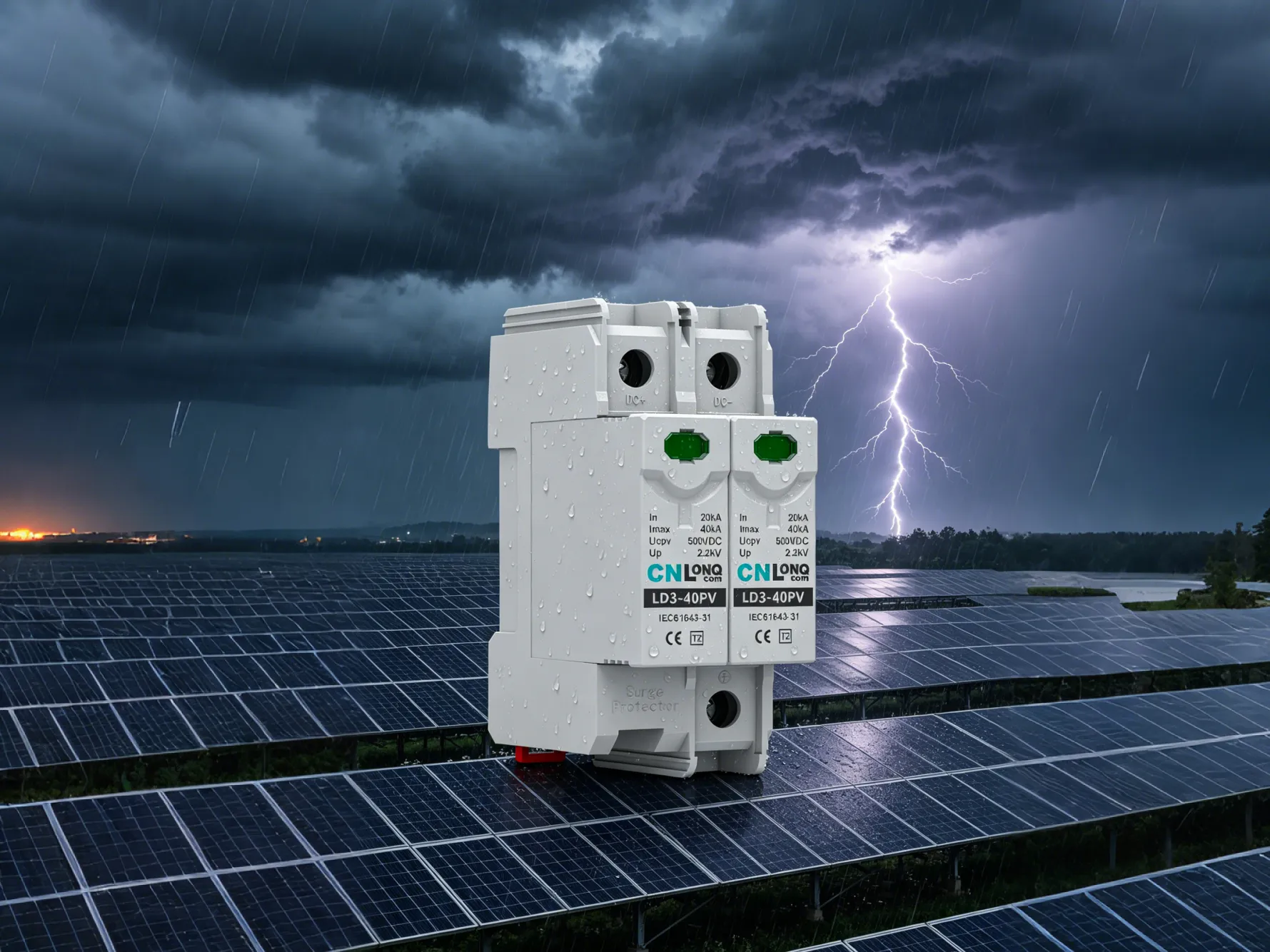
3. How to Install Surge Protectors to Protect Solar PV Power Plants?
The installation of surge protectors in solar PV systems must follow the principles of "graded protection, nearby protection, and reliable grounding". Combined with the system architecture (centralized, string-type), they should be reasonably arranged on the DC side, AC side, and control signal side to form a comprehensive surge protection system. At the same time, strict compliance with installation specifications is required to avoid affecting the protection effect due to improper installation. The specific installation points are as follows:
3.1Selection of Installation Location
Surge protection of solar PV systems needs to cover the entire link of "modules — combiner boxes — inverters — grid-connected cabinets". The key installation locations are divided into 3 categories:
3.2 DC Side Installation: It mainly protects solar modules, combiner boxes, and the DC input terminals of inverters, divided into two-level protection. The first level is installed between the solar module string and the combiner box, or inside the combiner box, to suppress induced lightning surges from the module side; the second level is installed between the output terminal of the combiner box and the DC input terminal of the inverter to further weaken surge energy and protect the core components of the inverter. DC side SPDs need to provide protection for positive and negative poles to ground ( /PE, -/PE) to adapt to the high-voltage DC environment. If the distance between the inverter and the PV array is less than 10m, and the voltage protection level of the front-end SPD is ≤ 0.8 times the rated impulse withstand voltage of the PV array, some installation points can be omitted.
3.3 AC Side Installation: It mainly protects inverters, grid-connected cabinets, and grid-side equipment, installed at the AC output terminal of the inverter and inside the grid-connected cabinet. It is used to suppress surges caused by grid fluctuations and lightning waves invading from the grid side, with the protection mode mostly L-N/L-PE. It needs to be used with circuit breakers to adapt to AC system standards. If the distance between the main power distribution cabinet and the SPD in the inverter is less than 10m, repeated installation is not required.
3.4 Control Signal Side Installation: Installed at the signal interface of monitoring systems and data acquisition equipment, a dedicated signal SPD is selected to prevent surges from invading through signal lines, damaging control equipment, and ensuring normal system monitoring and data transmission.
3.5Installation Specification Requirements
- Installation Method: Priority is given to 35mm DIN rail installation, complying with the EN 60715 standard. Power-off operation is required during installation to avoid safety hazards caused by live work.
- Wiring Requirements: The SPD should be connected in parallel to the power line at the front end of the protected equipment. The length of the phase/neutral wire connection conductor should not exceed 1m, and the length of the ground wire should not exceed 0.5m. A radian should be reserved at the corner of the conductor to avoid right-angle bending; the connecting conductor should be selected with an appropriate cross-sectional area, with a minimum of not less than 1.5mm² single-strand wire and a maximum of 35mm² multi-strand wire to ensure conductive performance.
- Grounding Requirements: The grounding must be reliable, with a grounding resistance of less than 4Ω. The SPD is connected to the lightning protection equipotential bonding strip of the solar PV system to ensure that surge current can be quickly introduced into the ground; if the LPS (Lightning Protection System) and the PV module frame do not meet the safe spacing distance, shielded cables should be used, and both ends of the shielding layer should be grounded and able to carry part of the lightning current.
- Supporting Protection: A small circuit breaker or lightning protection fuse should be installed at the front end of the SPD to prevent faults caused by non-lightning strike accidents; the distance between the SPD and the protected equipment should not exceed 5m to ensure the protection effect.
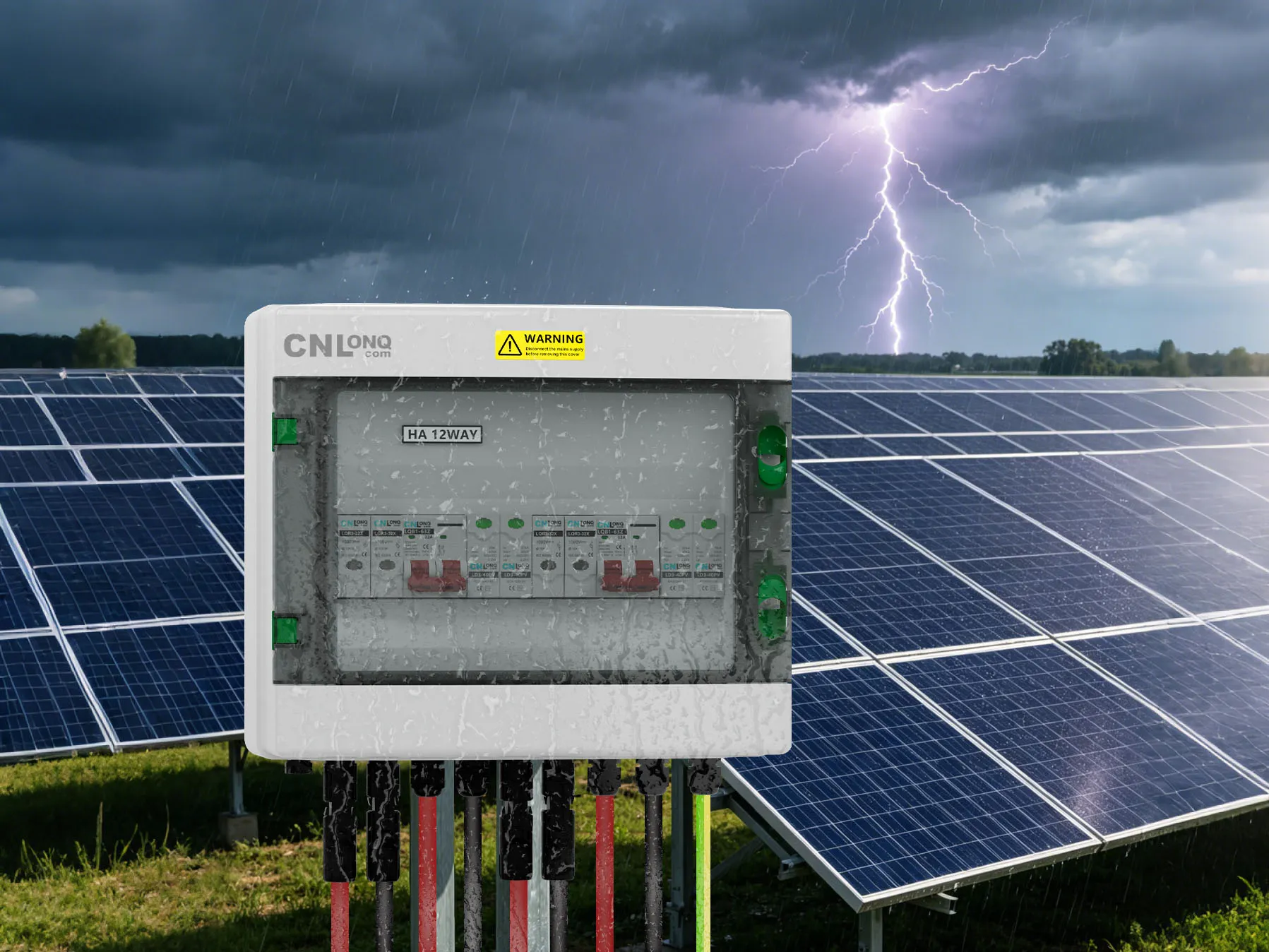
4..Surge Protector Purchasing Guide
The purchase of SPDs dedicated to solar PV systems should be comprehensively considered in combination with system parameters, service environment, protection requirements and other factors. The core is to ensure adaptability, reliability and safety, and avoid protection failure caused by improper selection. The specific purchasing points are as follows:
4.1 Clarify System Parameters to Ensure Adaptability
Voltage Parameter Matching: According to the working voltage of the DC side and AC side of the solar PV system, select the SPD with the corresponding continuous working voltage (Uc). The DC side SPD should be adapted to the maximum open-circuit voltage of the system (such as 1000V, 1500V systems), and the AC side should be adapted to 380V power frequency voltage. The Uc value should reserve sufficient safety margin to avoid accelerated aging due to long-term electrification. For example, the continuous working DC voltage of the DC side SPD for a 1000V solar PV system can be 500V to ensure adaptation to the system working conditions.
4.2 Selection of Current-Carrying Capacity: Combined with the lightning protection level of the area where the solar PV power plant is located and the number of down conductors, select the SPD with appropriate current-carrying capacity. For areas with high lightning protection level and more down conductors, products with strong current-carrying capacity should be selected. For DC side voltage-limiting SPDs, the impulse current (Iimp) and nominal discharge current (In) can be selected with reference to relevant standards. For example, when the lightning protection level is Class I and the number of down conductors is less than 4, a combination of Class I test SPD (Iimp ≥ 5kA) and Class II test SPD (In ≥ 8.5kA) can be selected, or only Class I test SPD (Iimp ≥ 8.5kA) can be used.
4.3 Adaptation of Protection Mode: The DC side adopts /-/PE bipolar protection mode, the AC side adopts L-N/L-PE protection mode, and the control signal side adopts dedicated signal protection mode to ensure full-link protection without dead ends.
4.4 Pitfall Avoidance Tips
- Do not mix AC SPDs: Using 220V AC SPDs in 1000V DC systems may lead to failure or explosion.
- Pay attention to fuse matching: The rated current of the backup fuse should be greater than the maximum possible current in the SPD branch, otherwise it cannot play a short-circuit protection role.
- A decoupler is required if the inter-stage distance is insufficient: If the distance between two levels of SPDs cannot meet the 10m requirement, a decoupling inductor must be connected in series to achieve energy coordination.
In summary, surge protectors are key supporting equipment for the safe and stable operation of solar PV systems. Correctly understanding their definition and working principle, standardizing installation and scientific purchasing can build a comprehensive surge protection system, effectively resist surge hazards, extend the service life of PV equipment, and ensure the long-term stable revenue of solar PV power plants.
