English
 Español
 Deutsch
 Français
 عربي
عربي
Musk's Game-Changing Move: SpaceX and Tesla to Deploy 200GW Solar Capacity in 3 Years, Ushering in a Dual Space-Ground Energy Era
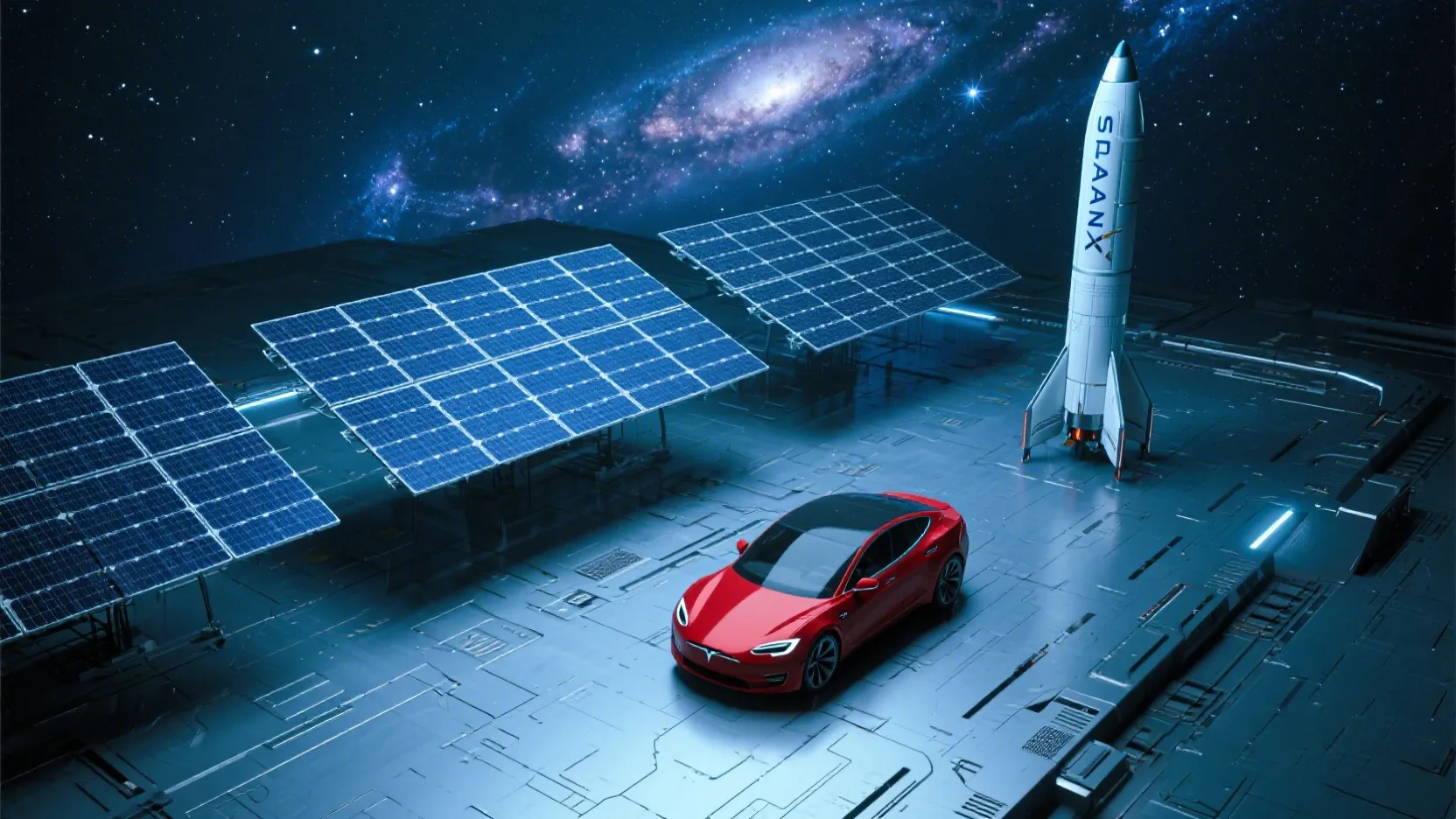
On January 22, 2026, a groundbreaking announcement for the global photovoltaic (PV) industry emerged from the World Economic Forum in Davos. Elon Musk, founder of SpaceX, officially revealed that his two companies, SpaceX and Tesla, will launch a deep strategic collaboration to jointly deploy 200 gigawatts (GW) of solar capacity in the United States over the next three years. Each entity will take on a 100GW target—SpaceX focusing on building a space-based solar energy network, and Tesla developing a ground-based solar manufacturing system. This initiative not only sets a global record for the largest single-phase solar capacity expansion but also marks the first large-scale commercial extension of solar technology from the ground to space, signaling that the global PV industry has officially entered a new era driven by both "space and ground" dual engines.
The 200GW solar capacity layout has clear scenario positioning and functional division, corely targeting the explosive growth in electricity demand during the AI era. SpaceX’s 100GW space-based solar capacity will leverage the low-cost, high-frequency launch capabilities of its Starship. The company plans to deploy approximately 1 million solar-powered AI satellites in space annually to build a space solar energy network, primarily providing continuous energy supply for the Starlink system, space computing centers, and AI satellites. Musk stated at the event that space, unobstructed by the atmosphere, offers nearly unlimited sunlight and stable radiation angles, enabling solar power generation efficiency 6 to 10 times higher than that on the ground. This achieves 24/7 uninterrupted power supply, perfectly addressing the industry’s key pain points of ground-based solar energy—intermittency and insufficient energy density. Meanwhile, Tesla’s 100GW ground-based solar capacity will focus on constructing a local manufacturing system, corely providing direct power supply services for Tesla’s own facilities and third-party data centers. It will also integrate energy storage systems to form a solar-storage integrated solution, filling the massive power gap of U.S. AI computing centers.
To adapt to the differentiated scenario requirements of space and ground, SpaceX and Tesla have customized exclusive technical routes for efficient technology matching. In the ground-based solar sector, Tesla will prioritize TOPCon (Tunnel Oxide Passivated Contact) technology. Benefiting from its high compatibility with existing PERC (Passivated Emitter and Rear Cell) production lines, low equipment investment costs, and mature mass production profitability, TOPCon technology will facilitate rapid capacity deployment while aligning with the U.S. domestic PV industrial chain. For space-based solar, a phased technical development path has been formulated: short-term focus on P-type HJT (Heterojunction) batteries, and long-term full commitment to HJT perovskite tandem batteries. Among these, P-type HJT batteries have emerged as the optimal solution for current space-based solar applications, thanks to their superior radiation resistance, ultra-thin and lightweight properties, and structural compatibility with flexible solar arrays. In the high-radiation space environment, their efficiency degradation is 40% lower than traditional products, with a thickness of only 50-70 microns—more than 50% lighter than conventional PERC batteries—greatly reducing satellite launch payload costs. As the core long-term technology, perovskite tandem batteries not only have a laboratory efficiency close to that of gallium arsenide but also possess lightweight and flexible characteristics, with outstanding radiation resistance. Trivalent perovskites experience only a 7% decrease in photoelectric quantum efficiency under equivalent radiation conditions, far outperforming traditional silicon carbide diodes, making them the core direction for large-scale space-based solar deployment in the future.
Currently, this large-scale solar layout has entered a substantive implementation phase, with both parties defining clear timelines and construction plans. Tesla’s ground-based capacity will be centered in Texas, with a 40GW solar capacity plan and the advancement of an initial 9GW order. The goal is to achieve 30GW/year capacity by the end of 2026 and 100GW/year manufacturing capacity by the end of 2028. Meanwhile, Tesla will launch the TSP-420 domestic module integrated with space technology to build a localized PV supply chain and avoid trade restrictions. SpaceX’s space-based solar layout is progressing in parallel: it will complete intensive Starship test flights in Q1 2026 to verify high-frequency launch capabilities, plan to launch the first 10MW-class demonstration satellite and complete power transmission tests by the end of 2026, and achieve 100GW/year space-based solar deployment capacity by the end of 2028, officially providing stable power supply for Starlink data centers.
In terms of industrial chain cooperation, key suppliers for the commercialization of space-based solar energy have been secured, with Chinese PV leader Risen Energy becoming a crucial partner in this initiative. It is reported that relying on technological breakthroughs in P-type ultra-thin heterojunction (HJT) batteries, Risen Energy has been supplying SpaceX in batches through compliant third parties since 2024, with a total delivery of over 50,000 batteries, accounting for more than 30% of SpaceX’s purchases. These products are mainly used in Starlink V2 mini satellites. The company’s HJT batteries have a mass production efficiency of 26.1%-26.2%, and the laboratory efficiency of its tandem perovskite technology has exceeded 30.99%, meeting the 25-year on-orbit service life requirements of satellites. In 2026, its monthly shipment target will be increased to 100,000 pieces, corresponding to 1GW annual capacity, which can meet the energy needs of approximately 30,000 satellites.
This cross-border solar layout by SpaceX and Tesla will not only reshape the capacity structure and application boundaries of the global PV industry but also unlock a hundreds-of-billions-dollar new market. Institutional estimates indicate that the market size of the space-based solar sector alone is expected to reach 500 billion US dollars, approximately 5 times that of the current ground-based solar market. Tesla’s 100GW ground-based capacity plan is equivalent to twice the current annual U.S. solar installed capacity, which will directly drive the demand explosion for upstream and downstream industrial chain segments such as solar cells, modules, and energy storage equipment in the U.S. domestic market. At the same time, this layout will accelerate the iteration of solar technologies, significantly advancing the R&D and commercialization of high-efficiency PV technologies such as perovskite and HJT. Moreover, the large-scale development of space-based solar energy provides a new development direction to address the problems of overcapacity and price competition in the ground-based solar industry.
Industry insiders stated that Musk’s "space ground" solar layout is a crucial milestone in the extension of solar technology from energy application to space science and technology. It not only provides an innovative solution for energy supply in the AI era but also opens up a blue ocean track for the PV industry. With the gradual implementation of the 200GW capacity, the global PV industrial chain will usher in a new round of technological upgrading and structural restructuring. Enterprises with space-based solar technology reserves, localized capacity layout, and solar-storage integrated solution capabilities will take the lead in seizing industry development opportunities.