English
 Español
 Deutsch
 Français
 عربي
عربي

Application case of combiner box in 3.2kW household photovoltaic power station in California, USA
Project Background
Brian's family lives in California, USA, and he has been seeking a sustainable energy solution to reduce their household energy consumption and electricity bills. Given the abundant local sunlight, solar power generation became an ideal choice. However, selecting the right solar power generation equipment presented numerous challenges, including compatibility, durability in outdoor environments, and system reliability and safety.
Customer Pain Points and Needs
1. Inadequate Input Adaptability: Traditional combiner boxes often have fixed circuits (e.g., 4 or 8), making them difficult to precisely adapt to low-power distributed scenarios (e.g., 2-input, 2-output), resulting in increased line loss and wasted interfaces.
2. Weak Outdoor Protection: Ordinary plastic or metal boxes are susceptible to high-temperature aging, rain penetration, and salt spray corrosion (California's coastal areas are occasionally affected by sea breezes), shortening equipment lifespan.
3. Lack of Safety Protection: The lack of efficient lightning protection modules and graded overcurrent protection (e.g., fuse and circuit breaker linkage) creates the risk of lightning damage and short-circuit fires.
4. Complex Maintenance: Internal wiring is confusing and labeling is unclear, requiring specialized personnel for subsequent troubleshooting, increasing time and costs. Solution: Customized service for 500V2-2 15A fuses, 32A circuit breakers, and combiner boxes.
1. Core Model Configuration and Electrical Performance
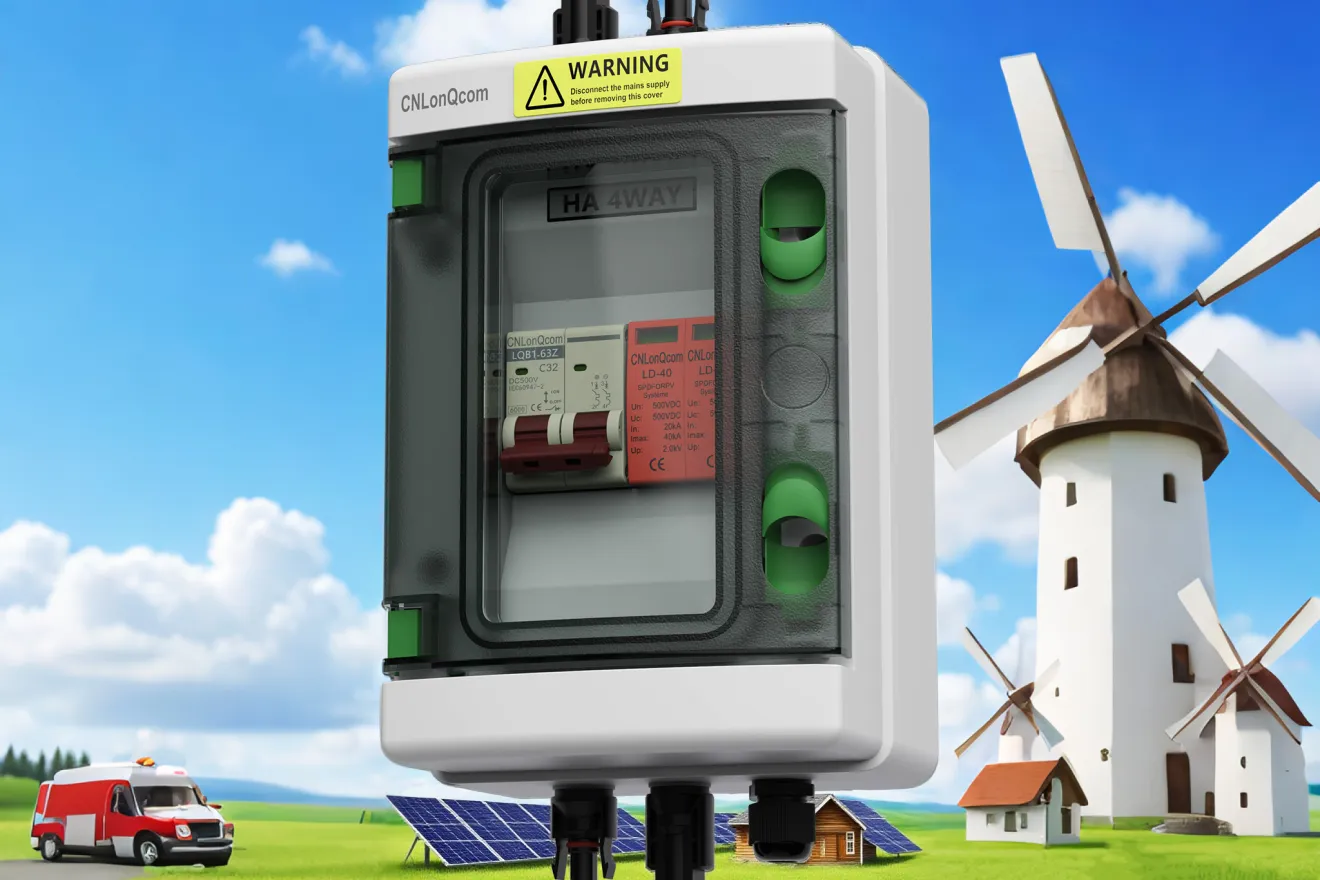
Input Adaptation: 2-input, 2-output design (precisely matches the farm's two 3200W module inputs), rated current per channel 9.6A (1.25x the module short-circuit current margin = 12A), rated voltage 167V, conversion efficiency ≥ 96.5%.
Electrical Components:
Input Side: 2P 15A fuses (LQPV-32 fast-blow protection, response time ≤ 0.1s) to protect against reverse current and short circuits in the modules.
Output Side: 32A circuit breaker (LQB1-63Z, overload protection short-circuit protection), combined with the fuses for dual protection.
Lightning Protection Module: LD-40 (LD1-40PV, nominal discharge current 20kA, maximum discharge current 40kA), compliant with IEC 61643-31, covering the needs of California's lightning-prone areas. Certifications: CE, ISO, and IEC certified, ensuring compatibility with the North American market.
2. Protective Design and Cabinet Structure
Case Material: Off-white, highly weather-resistant PC ABS composite material (3mm thick), UV-resistant (passes ASTM G155 500-hour testing), and coated with a nano-anti-corrosion coating (salt spray resistance ≥1,000 hours), suitable for the occasional California coastal breeze.
Sealing Design: IP65 protection rating (the "PASS" mark in Figure 2 indicates waterproof testing). Double-layer silicone sealing strips are installed around the cabinet edges, and a waterproof connector is installed at the bottom cable entry (tightening torque: 25 N·m) to prevent rain and dust intrusion.
Optimized Heat Dissipation: Diamond-shaped cooling holes are designed on both sides of the cabinet (30mm apart, with dust screens). Passive cooling fins (made of aluminum alloy) are installed on the top to ensure an internal temperature of ≤65°C (the component junction temperature safety threshold) even in high-temperature environments (45°C). 3. Customizable Layout and Ease of Installation
Internal Layout: Modular DIN rail mounting is used, with the circuit breaker, lightning protection module, and fuses arranged in zones (left to right: input fuse → lightning protection module → output circuit breaker). Red and black cables are secured with screws (torque 10 N·m).
Mounting Structure: Outdoor metal bracket adapted for sloping farmland. Seismic rubber pads are installed on the bracket bottom to withstand minor earthquakes (in the California seismic zone).
Project Highlights
Precisely adapted for low-power scenarios: The 2-input, 2-output design solves the "waste of large circuits" problem of traditional combiner boxes, reducing line losses by 1.2% and increasing system efficiency to 97%.
All-weather durability: Highly weather-resistant enclosure with IP65 protection and nano-coating, resulting in no aging or water intrusion after one year of installation (compared to the old farm equipment, which required replacement every two years).
Active Safety Protection: Triple protection with fuses, circuit breakers, and lightning protection modules, resulting in zero fault reports within 12 months of operation.
Project Achievements
1. Economic Benefit: Protected expensive PV systems and inverters, saving significant repair and replacement costs.
2. Reliability Verification: The equipment maintained stable operation despite California summer temperatures exceeding 45°C, winter rainstorms (up to 200mm of rainfall per day), and two strong winds (12m/s).
|
Parameter Item
|
Specification
|
Standard/Certification
|
Remarks
|
|
Model
|
LQX-DC500V2/1B1
|
IEC 61439-1 (Structural Standard), UL 1993 (Electrical Safety)
|
Specifically designed for 2-in 2-out PV systems
|
|
Rated Voltage
|
500V DC
|
IEC 60038 (DC Voltage Standard)
|
Compatible with 500V system
|
|
Single-channel Input Current
|
15A (Fuse) / 32A (Circuit Breaker)
|
UL 248-1 (Fuse Standard), IEC 60947-2 (Circuit Breaker Standard)
|
Fuse includes 1.25 times short-circuit current redundancy
|
|
Fuse
|
LDPV-32 (15A, Fast-blow Type)
|
RoHS (Lead-free Certification), IEC 60269-1
|
Response time ≤0.1s, anti-reverse current
|
|
Protection Class
|
IP65
|
IEC 60529 (Protection Standard)
|
Passed 720-hour salt spray test (ASTM B117)
|
|
Cabinet Material
|
PC ABS (Main Body)
|
UL 94 (Flame Retardant Class V-0)
|
UV aging resistance ≥15 years
|
|
Lightning Protection Class
|
T2 Surge Protector (Imax=40kA)
|
IEC 61643-1 (Lightning Protection Standard), GB 18802.1 (National Standard)
|
Varistor voltage 500V, residual voltage ≤2.2kV
|